Griha Pravesh Ritual Guide: Meaning, the Three Classical Types, and the Full Ceremony Explained
A complete guide to the Griha Pravesh ceremony — its meaning, the three classical types (Apoorva, Sapoorva, Dwandwa), the central Kalash Pooja and Vastu Shanti rituals, regional variations across India, and how modern families adapt the ceremony for urban homes.
Key takeaway
Griha Pravesh is the Hindu ceremony that turns a new house into a home. It is structured around the Kalash, the threshold, and the Vastu — a sequence of pooja and symbolic action that purifies the spa…
What is Griha Pravesh?
Griha Pravesh — literally ‘entering the home’ — is the Hindu ceremony performed to formally and auspiciously mark the start of family life in a new house. It is not a single fixed ritual but a structured sequence of pooja, mantras, and symbolic actions intended to purify the space, neutralise Vastu doshas (structural energetic imbalances), invoke the blessings of household deities, and consecrate the home for the family that will live in it.
Across most Hindu traditions, the ceremony shares a recognisable core — the Kalash, the diya, the threshold crossing, the puja to Ganesh and Lakshmi, and the first family meal in the new home — even as the specific sequence varies meaningfully by region, sampradaya, and family priest.
The three types of Griha Pravesh
Classical Hindu texts and modern priestly practice distinguish three types of Griha Pravesh, each with a slightly different ritual focus:
The three classical types
- Apoorva Pravesh — entry into a brand-new home, never previously occupied. This is the most common form and includes the full Vastu Shanti, Kalash Pooja, and Havan.
- Sapoorva Pravesh — re-entry into a home you have lived in before but left for an extended period (often more than a year). A shorter form, focused on re-consecrating the space and removing accumulated dormant energy.
- Dwandwa Pravesh — entry into a home after major renovation, structural repair, or restoration following damage (flood, fire, prolonged vacancy). Includes specific shanti rituals to address the disturbed energy of the modifications.
The Kalash Pooja — the heart of the ceremony
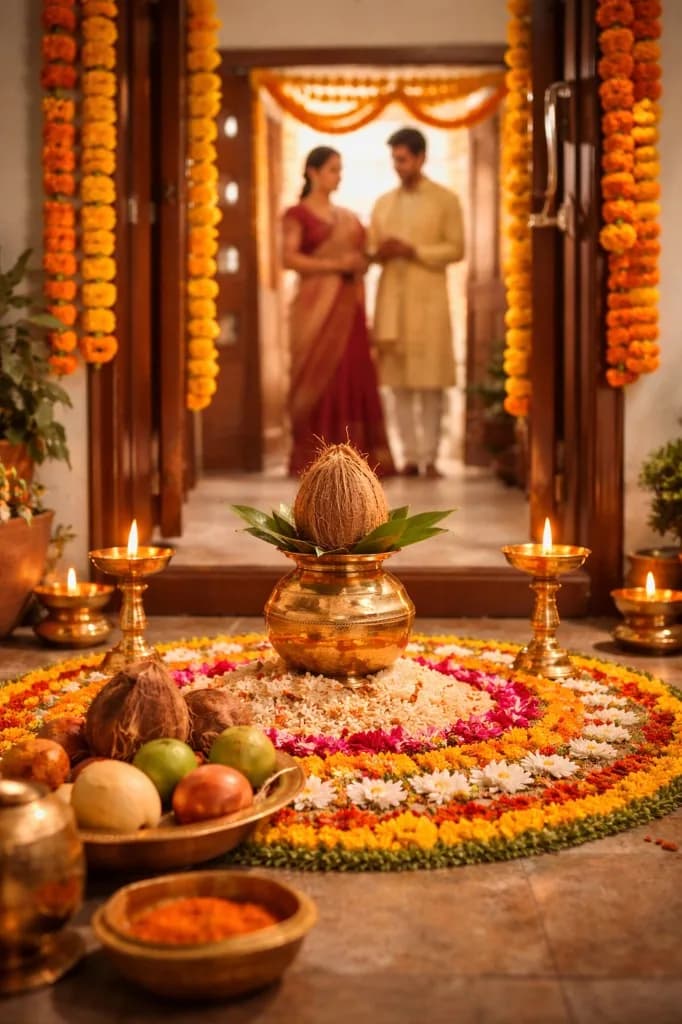
The Kalash — a copper or silver pot filled with water, with mango leaves arranged at the rim and a coconut placed on top — is the single most recognisable element of Griha Pravesh. It is not just decoration. In Hindu thought, the Kalash represents the entire structure of the cosmos in miniature.
What the Kalash symbolises
- The pot itself represents the universe — the container that holds all of existence.
- The water inside represents the primordial waters of creation, and purifies the atmosphere of the home.
- The five mango leaves represent the five elements (earth, water, fire, air, ether) — the building blocks of all matter.
- The coconut on top represents the divine consciousness — Lord Vishnu and Goddess Lakshmi together.
- The red thread tied around the pot represents the binding of blessings and protection.
- Many families place coins, turmeric, and rice grains inside the Kalash to invoke prosperity, auspiciousness, and abundance respectively.
In the ceremony, the Kalash is brought into the new home by the woman of the house — traditionally the wife of the householder — who carries it on her head from the threshold to the puja area. This carrying-in moment is one of the emotional peaks of the ceremony in most families.
Vastu Shanti — addressing the home’s energy
Vastu Shanti is the second major ritual of Griha Pravesh. ‘Vastu’ refers to the science of architecture and spatial energy; ‘Shanti’ means peace or pacification. Together, the ritual addresses any Vastu doshas — energetic imbalances in the structure’s orientation, layout, or alignment — that could affect the harmony of the household.
What Vastu Shanti does
- Invokes Vastu Purusha — the deity of the land and the structure itself — to bless the home.
- Pacifies any Vastu doshas arising from imperfect orientation, room placement, or structural compromises.
- Addresses the directional energies (the eight cardinal and intermediate directions) through specific mantras for each.
- Includes offerings to the Navagrahas (nine planetary deities) so that planetary influences on the home and family are favourable rather than disruptive.
- Establishes a positive energetic foundation for everyday family life in the space.
The full ritual flow
While the exact sequence varies by region and family priest, a typical Griha Pravesh ceremony moves through roughly nine stages over 3–5 hours:
Typical Griha Pravesh sequence
Most ceremonies follow this rough flow, though timing and order vary regionally.
- Step 1
Pre-ceremony preparation
Cleaning the home thoroughly, decorating the threshold with rangoli, hanging fresh mango leaves (toran) over the doorway, and arranging the puja samagri.
- Step 2
Threshold crossing
The family enters the home together at the muhurat (auspicious time), led by the householder. The woman of the house carries the Kalash. The right foot crosses the threshold first.
- Step 3
Ganesh Pooja
The first puja is always to Ganesh — the remover of obstacles. This sets the auspicious tone for everything that follows.
- Step 4
Kalash Sthapana
The Kalash is formally established at the puja location, with chants invoking the deities present in each element of the Kalash.
- Step 5
Vastu Shanti
The Vastu Shanti rituals are performed, including invocation of Vastu Purusha and offerings to the eight directions.
- Step 6
Navagraha Shanti
The nine planetary deities are invoked and pacified to ensure favourable cosmic influence on the home.
- Step 7
Havan
The sacred fire is lit and offerings (ghee, herbs, grains) are made into it with mantras. The havan smoke is considered to consecrate the space.
- Step 8
First milk boil
Milk is boiled until it overflows in the new kitchen — a powerful symbol of abundance overflowing in the family’s new home. This is often the most-photographed moment.
- Step 9
Prasad and family meal
Prasad is distributed, and the family shares the first formal meal together in the new home with guests.
Regional variations
Griha Pravesh is widely practised across India but the form varies meaningfully:
Major regional variations
- North India (Punjabi, Haryanvi, UP, Bihar) — typically includes elaborate Vastu Shanti and Havan, with the Kalash entry being the central moment. Often accompanied by family-led bhajans.
- Gujarat — ‘Vastu Pravesh’ is often the preferred term; the ceremony may include the breaking of a coconut at the threshold and a specific kalash-boiling ritual called ‘ghado mukavo’.
- Maharashtra — includes the unique ‘Vastu Shanti’ as a multi-hour ceremony, often spread across the morning, with elaborate havan and the Vastu Purusha mandala drawn at the centre of the home.
- Tamil Nadu and South India — ‘Gruhapravesam’ includes specific rituals like the boiling of milk (paal kachudal) in the new kitchen, which is the moment everyone waits for. The Kanchipuram silk and brass Kalash are particularly elaborate.
- Bengal — ‘Griha Pravesh’ or ‘Naba Griha Pravesh’ often includes Sankha Pravesh (the conch-shell entry) and specific Lakshmi-Narayana puja emphasis.
- Kerala — ‘Grihapravesham’ ceremonies often coordinate the entry with the family deity’s preferences and may include specific Nair-community or Namboodiri-Brahmin variations.
Choosing the muhurat (auspicious timing)
The timing of Griha Pravesh is taken seriously in most traditions. Several months are considered particularly auspicious — Magh (Jan-Feb), Phalgun (Feb-Mar), Vaishakh (Apr-May), and Margshirsha (Nov-Dec) — while others, like Ashadh and Shravan, are typically avoided in many traditions. Within an auspicious month, the family priest will identify a specific muhurat based on the nakshatra, tithi, and the householder’s natal chart.
Practical muhurat factors families consider
- Possession date — the legal handover of the property must precede the ceremony.
- Utilities (water, electricity, gas) must be functional before entry.
- Travel time for outstation elders and relatives.
- School/work schedules of immediate family.
- Caterer and priest availability on the proposed date.
- Weather and travel considerations (monsoon dates often complicated logistically).
Modern adaptations
Most urban Indian families today do a meaningfully simpler Griha Pravesh than their grandparents would have done. The core elements — Kalash, threshold, Ganesh puja, Vastu Shanti, milk boil, family meal — remain, but the duration and elaboration are often scaled back to fit working schedules, smaller homes, and modern guest patterns.
Do
- Keep the core ritual elements meaningful even when you simplify — the Kalash, the threshold crossing, the first milk boil are non-negotiable for most families.
- Coordinate priest timing, kitchen access, utilities, and guest logistics in advance — these are the things that go wrong on the day.
- Make the ceremony accessible — older family members need seating during the puja, outstation guests need clear directions and timing.
- Photograph the threshold crossing, Kalash entry, and milk-boil moments — these are the family memory anchors.
Do not
- Try to compress a full three-hour ceremony into 45 minutes — either do a proper short ceremony designed by the priest, or do the full version with planned breaks.
- Treat the social-display side (catering, decor, photographer) as more important than the ceremony itself.
- Skip the Vastu Shanti because the home’s layout is imperfect — the ritual is specifically designed for imperfect layouts.
- Make absolute claims about ‘the correct way’ — even close family branches will have different practices.
Host planning checklist
Practical Griha Pravesh planning
- ✓Priest confirmed for the muhurat (book 2-3 weeks in advance).
- ✓Puja samagri list from the priest (Kalash, coconut, mango leaves, ghee, rice, turmeric, sindoor, cotton wicks, agarbatti, dhoop, camphor, ghee lamp, fresh flowers).
- ✓Threshold area set up with rangoli, fresh mango leaves toran, and a clean entrance.
- ✓Footwear flow planned — guests should know where to leave shoes before entering.
- ✓Kitchen prepped for the milk-boil moment — vessel ready, milk available.
- ✓Seating arranged for elders during the longer puja sections.
- ✓Water, snacks, and prasad service planned.
- ✓Photographer or family designated to capture the key moments.
- ✓Digital invite shared with map, timing, and dress code at least 2 weeks before.
- ✓RSVP collected so catering count is accurate.
Final thoughts
Griha Pravesh is one of the few Hindu ceremonies that is essentially a beginning — not a marker of a stage already reached, but the consecration of a stage about to begin. The Kalash you carry in, the milk you boil over, the threshold you cross with your family beside you: these are the symbols by which the home stops being a structure and starts being a household. Done with intention, even a short and modest ceremony works. Done as performance, even an elaborate one feels hollow. The right Griha Pravesh is the one that genuinely marks the moment for the people who will live in the home.
Helpful links
Keep exploring — invitation hubs
Templates, occasions, and wording — strong paths from this article into the product surface.
FAQs – Griha Pravesh Ritual Guide: Meaning, the Three Classical Types, and the Full Ceremony Explained
Is Griha Pravesh compulsory?
No — it is a meaningful family custom rather than a religious obligation. Many Hindu families consider it important; the format and elaboration depend on family tradition, priestly guidance, and practical context.
What is the difference between Apoorva, Sapoorva, and Dwandwa Pravesh?
Apoorva Pravesh is for a brand-new home never lived in before (the most common form). Sapoorva Pravesh is re-entry after a long absence from a home you previously occupied. Dwandwa Pravesh is for re-entry after major renovation or restoration.
Can we do a simplified Griha Pravesh?
Yes. Many urban families do a 2–3 hour version focused on the Kalash, threshold crossing, Ganesh and Vastu puja, milk boil, and family meal — keeping the core meaning while scaling down the duration.
What is the Kalash and why does it matter?
The Kalash is a copper or silver pot filled with water, mango leaves, and a coconut. It represents the universe in miniature — the pot is the cosmos, the water is creation, the leaves are the five elements, and the coconut is divine consciousness. It is the symbolic centre of the ceremony.
Why is the milk boiled over in the new kitchen?
The first milk boil in the new kitchen is a powerful symbol of abundance overflowing in the family’s new home. It is one of the most-photographed moments of the ceremony and is considered especially auspicious in South Indian (paal kachudal) and Maharashtrian traditions.
When should we do Griha Pravesh?
Several months are considered auspicious — Magh, Phalgun, Vaishakh, Margshirsha — while Ashadh and Shravan are typically avoided. Within an auspicious month, a family priest will identify a specific muhurat based on the nakshatra, tithi, and the householder’s natal chart.
Do all regions follow the same Griha Pravesh format?
No. North, West, South, and East Indian formats differ meaningfully in puja sequence, mantras, and specific symbolic acts. Even within one region, two families often follow different but equally valid traditions.
Read next
Continue your learning journey with these related guides.

Invitation wording
Griha Pravesh Invitation Message Ideas: English Templates for Cards, Digital Invites, and WhatsApp
Griha Pravesh invitation message templates in English — formal printed-card wording, warm digital invite versions, short WhatsApp messages, plus the practical lines covering muhurat timing, havan window, lunch arrangement, and the dress comfort note most invitations miss.
5 min read
Hindi messages
Griha Pravesh Invitation Message in Hindi: Templates for Cards, Family WhatsApp, and Elder-Facing Invites
Griha Pravesh invitation messages in Hindi for printed cards, family WhatsApp groups, and elder-facing invites — with formal Shuddh Hindi templates, warm Hinglish for cousins, and clean Devanagari options for the puja muhurat, havan timing, and lunch arrangement.
5 min read
Housewarming
Housewarming Invitation Text for WhatsApp: Forward-Ready Messages for Every Format
WhatsApp-ready housewarming invitation messages — short five-line formats, casual apartment housewarming texts (no big puja), formal Griha Pravesh forwards, voice-note scripts, family-group templates, and the practical lines covering parking, dress code, and lunch arrangement.
6 min read

Planning
What Details Should Every Invitation Include: The Complete Checklist for Indian Events
Ek complete invitation me kuch cheezein mandatory hain, kuch optional, aur kuch situational. Yahaan ek systematic checklist — must-have details, important-but-optional details, multi-day function ke liye special considerations, aur woh small details (parking, kids policy, dress code) jo guest experience ko make-or-break kar dete hain.
10 min read

Wedding
Indian Wedding Ceremony Guide: Rituals, Meaning, Regional Variations, and Modern Relevance
A practical guide to Indian wedding rituals, regional traditions, family variations, and modern wedding planning.
5 min read