Traditional Indian Wedding Invitation Wording: Classic Examples for Every Family Style
Carefully written traditional Indian wedding invitation wording examples — the elder host-line format, the family-and-ceremony format, the religion-specific framings, and how to adapt classic wording for printed cards, digital invites, and modern weddings without losing the dignity.
Key takeaway
A traditional Indian wedding invitation does something a modern minimal one cannot — it places the wedding within the lineage and continuity of two families. The host line is not just an opening; it i…
What makes wording ‘traditional’
A traditional wedding invitation is recognisable by its structure as much as its language. Modern invitations often lead with the couple’s photo and a tagline; traditional invitations lead with the families, name the parents, place the wedding within a religious or community frame, and request blessings rather than presence alone. The wording is fuller, the verbs are heavier, and the request to attend is wrapped in cultural protocol that recognises the guest as someone whose blessing matters.
Structural elements of a traditional invitation
- Invocation or opening blessing — ‘Shri Ganeshay Namah’, ‘Ek Onkar Satnam’, ‘Bismillah ir-Rahman ir-Raheem’, or a family motto.
- Host line naming the parents or family elders.
- Couple’s full names with parental references (‘son of’, ‘daughter of’) and often family lineage.
- Specific event names — main ceremony as well as connected functions.
- Date and time with day of week, often the Hindu calendar date alongside.
- Venue with full address and increasingly a map link.
- Request for blessings, not just presence — ‘shubh aashirwad’, ‘holy blessings’.
- RSVP information.
Classic Hindu wedding wording
Hindu wedding invitations traditionally begin with an invocation to Lord Ganesh (the remover of obstacles) and a reference to the auspicious occasion (‘shubh vivah’). The host line is typically the parents, with their names presented in full respect form.
Hindu wedding wording examples
- ‘Shri Ganeshay Namah. With the blessings of the Almighty and our elders, Shri [Father’s Name] and Smt. [Mother’s Name] joyfully invite you to the shubh vivah of their daughter [Bride’s Name] with [Groom’s Name], son of Shri [Father’s Name] and Smt. [Mother’s Name], on [Date] at [Venue]. Your blessings and presence will sanctify the occasion.’
- ‘With the grace of Lord Ganesha and the blessings of our elders, we cordially invite you to the wedding ceremony of our beloved children [Bride] and [Groom]. The shubh muhurat will commence at [Time] on [Date] at [Venue]. Kindly grace us with your presence.’
- ‘On the auspicious occasion of the shubh vivah of [Bride], daughter of [Father’s Name] and [Mother’s Name], with [Groom], son of [Father’s Name] and [Mother’s Name], the families request the honour of your presence and blessings. [Date], [Venue], [Time].’
Classic Sikh wedding wording (Anand Karaj)
Sikh wedding invitations centre around the Anand Karaj ceremony, conducted in the presence of the Guru Granth Sahib. Traditional invitations open with the Sikh invocation and place the marriage explicitly within the Anand Karaj framework rather than a generic ‘wedding ceremony’ phrasing.
Sikh wedding wording examples
- ‘Ek Onkar Satnam. With the blessings of Waheguru and the Guru Granth Sahib, S. [Father’s Name] and Sardarni [Mother’s Name] invite you to the Anand Karaj of their daughter [Bride’s Name] with [Groom’s Name], son of S. [Father’s Name] and Sardarni [Mother’s Name], on [Date] at [Gurudwara/Venue]. Your sangat and ashirwad are humbly requested.’
- ‘With the grace of Waheguru, we cordially invite you to the Anand Karaj ceremony of [Bride] and [Groom] on [Date] at [Gurudwara Name], [City]. Laavaan will commence at [Time]. Langar will follow.’
- ‘Waheguru ji ki Fateh. The blessed union of [Bride] and [Groom] will be solemnised in Anand Karaj on [Date] at [Gurudwara]. Your presence, sangat and blessings would be deeply appreciated.’
Classic Muslim wedding wording (Nikah)
Muslim Indian wedding invitations traditionally open with the Bismillah and frame the wedding around the Nikah ceremony. The invitation often references the families with respect titles and may include separate function blocks for the Mehndi, Nikah, and Walima.
Muslim wedding wording examples
- ‘Bismillah ir-Rahman ir-Raheem. With the blessings of Allah, Janab [Father’s Name] and Mohtarma [Mother’s Name] cordially invite you to the Nikah ceremony of their daughter [Bride’s Name] with [Groom’s Name], son of Janab [Father’s Name] and Mohtarma [Mother’s Name], on [Date] at [Venue]. The Walima will follow at [Time].’
- ‘In the name of Allah, the Most Merciful. The families of [Bride] and [Groom] joyfully invite you to celebrate the Nikah and Walima on [Date] at [Venue]. Mehndi to be held on [Date]. Your presence and duas would mean the world.’
- ‘With deep gratitude to Allah, we invite you to the Nikah and Walima of [Bride] and [Groom]. [Date], [Venue]. Your blessings and presence are humbly requested.’
Classic Christian Indian wedding wording
Christian Indian wedding invitations follow a slightly different convention rooted in church-ceremony tradition. The wording typically references the Holy Matrimony, names the parents as hosts, and includes the church and reception venue separately.
Christian wedding wording examples
- ‘With grateful hearts and the blessing of God, Mr. and Mrs. [Father’s Name] cordially invite you to the Holy Matrimony of their daughter [Bride’s Name] with [Groom’s Name], son of Mr. and Mrs. [Father’s Name], on [Date] at [Church Name]. Reception to follow at [Venue].’
- ‘The families of [Bride] and [Groom] request the honour of your presence at their wedding ceremony on [Date] at [Church]. The marriage service will commence at [Time]. Reception at [Venue] from [Time].’
- ‘By the grace of God, [Couple] will exchange their vows on [Date] at [Church]. Your blessings and presence are warmly requested. Reception details: [Venue], [Time].’
Modern adaptations of traditional wording
Many modern weddings want to preserve the dignity of traditional wording while adapting it for digital invites, mobile screens, and a guest list that mixes elders with younger family. Some practical adaptations work better than others:
Do
- Keep the invocation or blessing line — it carries cultural weight without taking much space.
- Keep parental references in the host line — even on couple-led invites, naming parents recognises lineage.
- Use the religious or community-specific ceremony name (Anand Karaj, Nikah, Vivah) — generic ‘wedding’ feels emptier.
- Carry traditional wording on the formal printed card and on the main digital invite headline; use shorter modern versions for WhatsApp.
Do not
- Translate traditional invocations into casual English (‘With blessings from above’ flattens ‘Shri Ganeshay Namah’).
- Mix highly traditional opening with a casual closing — the tone should hold throughout.
- Skip the host line entirely on the formal invite to feel modern — it can read as disrespectful to elders.
- Use traditional formal English on a WhatsApp message — it reads as overdone in that medium.
Bilingual traditional wording
Many Indian families want a printed card that respects both an English-speaking and a Hindi-speaking guest pool. The cleanest pattern is parallel text — one side or one block in Devanagari Hindi, the other in English, with both following the same structural elements. Avoid mixing scripts mid-sentence; it makes both versions harder to read.
Final thoughts
Traditional Indian wedding wording works because every part of it earns its place — the invocation roots the wedding in faith, the host line places it within families, the parental references honour lineage, the ceremony name recognises tradition, and the request for blessings invites the guest as a participant rather than an attendee. Adapt the structure to your medium, but resist the urge to strip the elements; what reads as ‘heavier’ in word count is what carries the weight of the occasion.
Helpful links
Keep exploring — invitation hubs
Templates, occasions, and wording — strong paths from this article into the product surface.
FAQs – Traditional Indian Wedding Invitation Wording: Classic Examples for Every Family Style
Should we include parents’ names on a modern Indian wedding invitation?
On the formal printed card and the main digital invite headline, yes — naming parents recognises lineage and is culturally expected in traditional Indian weddings. On a short WhatsApp message, the parent line is often dropped.
What is the difference between ‘shubh vivah’ and ‘wedding ceremony’?
‘Shubh vivah’ specifically references the auspicious Hindu wedding ceremony and carries cultural and religious weight. ‘Wedding ceremony’ is the generic English term. Use ‘shubh vivah’ on traditional Hindu invitations; both work on bilingual digital invites.
Can a Sikh wedding invitation use the word ‘wedding’ instead of Anand Karaj?
It can, but ‘Anand Karaj’ is the specifically Sikh term and carries the religious framing properly. Traditional Sikh invitations use Anand Karaj; modern invitations sometimes use ‘wedding ceremony (Anand Karaj)’ in parallel.
Is it necessary to start with an invocation?
Not strictly, but it is the traditional convention. ‘Shri Ganeshay Namah’ for Hindu, ‘Ek Onkar Satnam’ for Sikh, ‘Bismillah’ for Muslim, ‘With grateful hearts and the blessing of God’ for Christian — the opening line is part of what makes the wording feel traditional rather than generic.
How long should a traditional wedding invitation be?
Printed card: 10–18 lines, often spread across two pages. Digital invite: full traditional wording on the headline page; structured detail below. WhatsApp: a short summary plus a link to the full invite.
Read next
Continue your learning journey with these related guides.

Invitation wording
Wedding Invitation Wording Ideas in English: Templates for Every Tone and Function
Carefully crafted English wedding invitation wording for traditional cards, digital invites, and WhatsApp messages — with templates for formal, warm-family, and modern couple-led weddings, plus guidance on what to include and what to leave out.
6 min read

Hindi messages
Wedding Invitation Message in Hindi: Templates for Cards, WhatsApp, and Digital Invites
Hindi and Hinglish wedding invitation message templates for cards, WhatsApp, and digital invites — with formal Shuddh Hindi versions for elders, warm Hinglish versions for family WhatsApp groups, and short scannable versions for digital invites.
5 min read
RSVP
RSVP Wording for Indian Invitations: Templates That Actually Get Replies
Carefully written RSVP wording examples for Indian invitations — formal lines for printed cards, warm lines for family WhatsApp groups, urgent lines for caterer deadlines, multi-function lines for multi-day weddings, and the small phrasings that double your reply rate.
5 min read
Wedding
Haldi Invitation Wording: Templates for Every Tone, With Dress Code and Timing Guidance
Haldi invitation wording that captures the joy of the ceremony without dropping the practical details — formal English templates, warm family Hindi, playful Hinglish, plus guidance on dress code, timing, and what to tell guests about turmeric stains.
5 min read
Wedding
Mehendi Invitation Message Ideas: Wording for Cards, Digital Invites, and WhatsApp
Mehendi invitation message ideas that get the practical logistics right — artist booking windows, who is welcome, dress code, and the right tone for cousins versus elders, with templates in formal English, Hindi, and warm Hinglish.
5 min read
Wedding
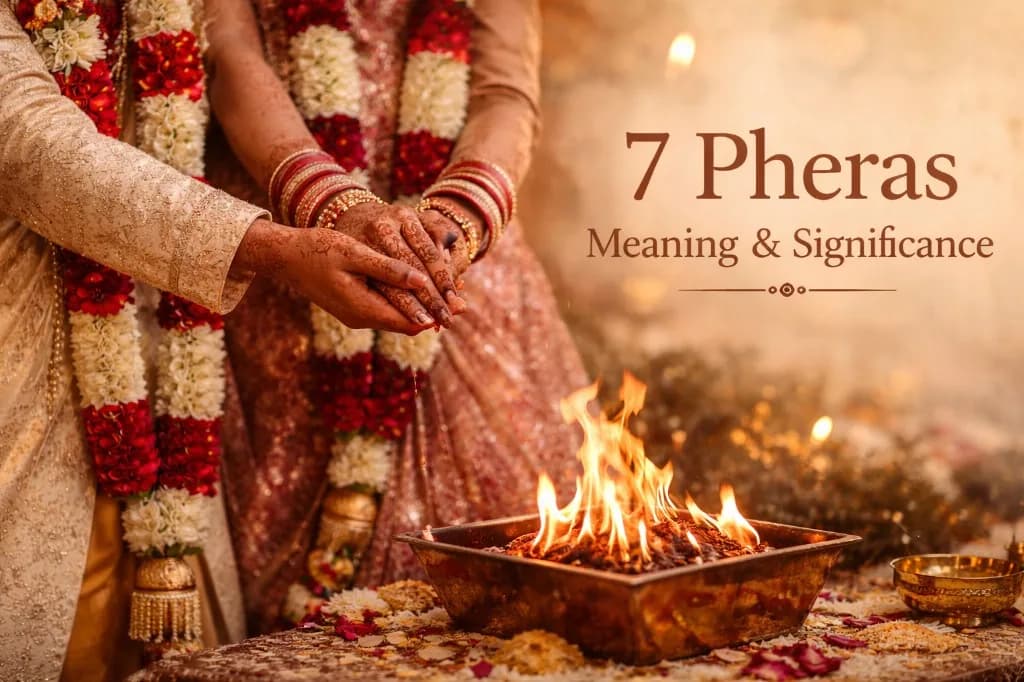
7 Pheras Meaning Guide: Significance, Symbolism, and Modern Relevance
A detailed guide to the meaning of the 7 Pheras, their symbolism in Hindu weddings, family variations, and modern significance.
4 min read