Roka Ceremony Guide: Meaning, Traditions, Family Significance, and Benefits
A detailed guide to the Roka ceremony, its meaning, family importance, regional customs, and modern relevance in Indian weddings.
Key takeaway
The Roka ceremony is often one of the first formal milestones in the wedding journey for many Indian families. It is the moment when the relationship is acknowledged, the families come together with i…
What is the Roka ceremony?
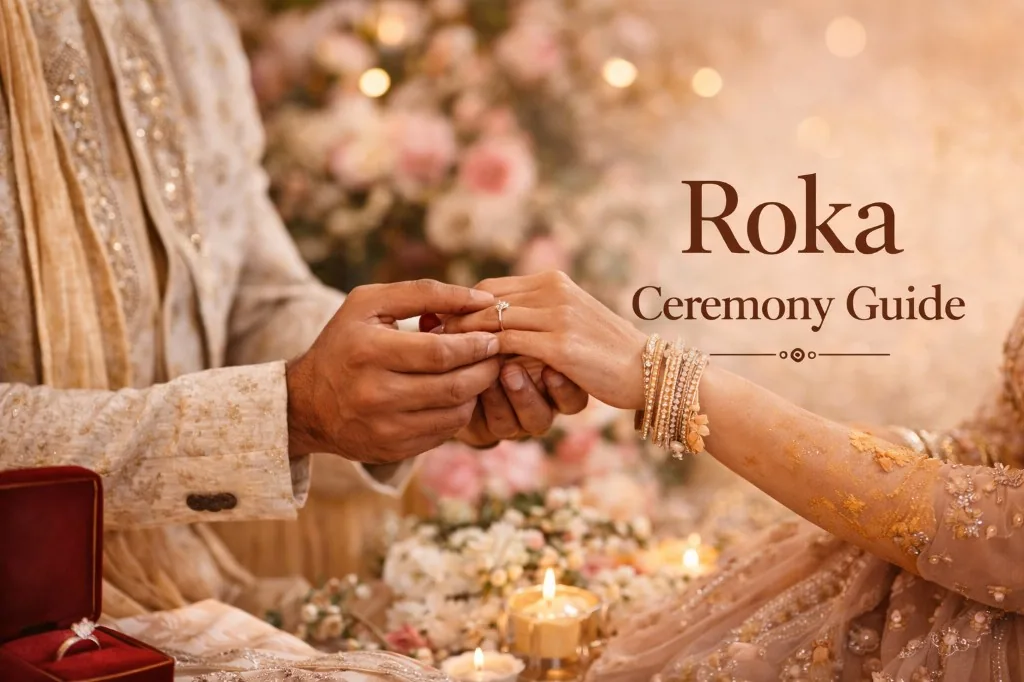
The Roka ceremony is a pre-wedding family event that formally marks the mutual acceptance of a marriage match. In many families, it is the occasion where both sides acknowledge the relationship, bless the couple, and indicate that the wedding process has officially begun. Depending on family custom, Roka may include meeting relatives, exchanging sweets or gifts, offering blessings, and sharing a meal together.
In simple terms, Roka often means that the families are now committed to moving forward with the marriage journey.
Why is the Roka ceremony important?
- Family approval and acceptance.
- Beginning of wedding planning.
- Blessings for the couple.
- Public or semi-public acknowledgment of the relationship.
- Emotional reassurance for both sides.
- Start of a new bond between families.
In many households, Roka is valued because it turns an understanding into a shared family commitment.
Culturally and traditionally, why did the Roka ceremony begin?
The Roka ceremony is generally best understood as a cultural and family-centered tradition rather than a universally required religious ritual. In many Indian communities, marriages have historically involved not only the couple but also the agreement, participation, and relationship between families. A ceremony like Roka makes this transition visible and provides a respectful way to formally acknowledge a match before larger wedding events begin. This is social-ritual grounding, not a single pan-India scriptural mandate.
Cultural significance
- Formal first step before detailed planning.
- Expression of commitment and goodwill between sides.
- Social acknowledgment of relationship in family network.
- Space for blessings before larger ceremonies.
Does Roka have a religious meaning?
- Blessings from elders.
- A small prayer or puja in some families.
- Exchange of sweets as an auspicious gesture.
- Symbolic gifts or tokens of affection.
Roka can feel spiritually meaningful, but it is often more accurate to describe it as a culturally important family ceremony rather than a universally defined religious rite.
What usually happens in a Roka ceremony?
- Both families meet formally.
- Blessings for the couple.
- Exchange of sweets, gifts, or flowers.
- Small ritual, prayer, or tilak in some families.
- Couple introductions or family announcements.
- Photographs and shared meal.
- In modern settings, decor and compact event setup.
Regional and family variations across India
North India
- Roka is especially well known in many North Indian wedding traditions.
- In some Punjabi and North Indian families, it is an important formal step before engagement or wedding planning.
South India
- The exact term Roka may not be commonly used in the same way.
- Families may have other formal pre-wedding customs that serve a similar purpose.
West India
- Some families have equivalent acknowledgment customs.
- Naming, sequence, and event style can vary; engagement-type ceremonies may be more prominent.
East India
- The exact concept or naming of Roka may not always be central in the same way as in some North Indian weddings.
- Pre-wedding acknowledgment practices differ by family and community.
What are the practical and social benefits of the Roka ceremony?
- Clear formal starting point.
- Reduced confusion about next steps.
- Emotional reassurance for the couple.
- Comfortable early interaction between families.
- Opportunity for elders to bless relationship early.
- Warm tone for the wedding journey.
Are there scientific or psychological benefits to Roka?
Roka is not a medical or scientific ritual. However, ceremonies that create social clarity, family support, and emotional acknowledgment can have psychological value in everyday life. Formal family acknowledgment may reduce uncertainty, and early bonding may improve comfort and trust around a major life transition.
Responsible framing
- ✓Possible emotional and social value can be described.
- ✓Avoid scientific guarantee language.
- ✓Do not frame Roka as medical intervention.
How modern families celebrate Roka today
- Elegant home decor or venue setup.
- Coordinated outfits.
- Personalized backdrops.
- Photography and videography.
- Close friends with relatives.
- Digital invitations.
- Announcement-style formats.
- Meal, brunch, or dinner.
Tips for planning a Roka ceremony
- ✓Decide intimate vs extended-family format.
- ✓Communicate timing and location clearly.
- ✓Keep ceremony warm and comfortable.
- ✓Include elders meaningfully.
- ✓Avoid overcomplicating the first family event.
- ✓If gifts/tokens are exchanged, keep expectations respectful and clear.
- ✓Use digital invites if guest coordination is needed.
What guests should know before attending
Roka is usually family-formal and emotionally significant, even when the setup looks simple.
Quick guest notes
- Expect elder-led blessings and close-family introductions.
- Gift or token exchange expectations vary by family and should be shared clearly.
- The event can be intimate, so timing and guest list boundaries matter.
- First-time attendees may need a one-line note on how Roka differs from engagement.
- Ceremony photos are common, but ritual moments are usually brief and structured.
A little context helps guests participate warmly without treating Roka like a full wedding function.
How to mention Roka in an invitation
- Event name
- Date and time
- Venue
- Family or couple details
- RSVP
- Optional note if intimate gathering
With the blessings of our families, we are delighted to invite you to our Roka ceremony as we begin this beautiful wedding journey together.
Final thoughts
Roka turns a private understanding into a shared family moment. Whether deeply traditional or modern and intimate, it remains meaningful because it creates clarity, acceptance, and a visible first step toward marriage.
Helpful links
Keep exploring — invitation hubs
Templates, occasions, and wording — strong paths from this article into the product surface.
FAQs – Roka Ceremony Guide: Meaning, Traditions, Family Significance, and Benefits
Is Roka compulsory in every Indian wedding?
No. Roka is common in many North Indian families, but it is not universal across all Indian weddings.
Is Roka the same as engagement?
Not always. In some families, Roka and engagement are separate events, while in others they may be combined or understood differently.
Is Roka religious?
Roka may include blessings or prayer, but it is usually better understood as a culturally important family ceremony rather than a universally defined religious ritual.
Does Roka have scientific benefits?
It is more accurate to describe Roka as a ceremony with possible emotional and social benefits through family support, clarity, and reassurance rather than scientific or medical benefit.
Read next
Continue your learning journey with these related guides.
Wedding
Indian Wedding Ceremony Guide: Rituals, Meaning, Regional Variations, and Modern Relevance
A practical guide to Indian wedding rituals, regional traditions, family variations, and modern wedding planning.
5 min read
Wedding
Haldi Ceremony Guide: Meaning, Rituals, Regional Variations, and Benefits
A detailed guide to the Haldi ceremony, its meaning, origins, regional customs, and modern relevance in Indian weddings.
4 min read
Wedding
Mehendi Ceremony Guide: Meaning, Traditions, Regional Variations, and Benefits
A detailed guide to the Mehendi ceremony, its meaning, origins, regional customs, and modern relevance in Indian weddings.
4 min read
Wedding
Sangeet Ceremony Guide: Meaning, Traditions, Regional Variations, and Benefits
A detailed guide to the Sangeet ceremony, its meaning, origins, regional customs, and modern relevance in Indian weddings.
4 min read
Invitation wording
Traditional Indian Wedding Invitation Wording: Classic Examples for Every Family Style
Carefully written traditional Indian wedding invitation wording examples — the elder host-line format, the family-and-ceremony format, the religion-specific framings, and how to adapt classic wording for printed cards, digital invites, and modern weddings without losing the dignity.
6 min read
Invitation wording
Haldi Invitation Messages: WhatsApp, Story, and One-Line Templates That Forward Well
Haldi invitation messages designed for forwarding — short WhatsApp lines, Instagram story versions, voice-note scripts, image captions, and quick-share templates that get the practical information across in five lines or less.
5 min read
On this page
- What is the Roka ceremony?
- Why is Roka important?
- Cultural and traditional origins
- Does Roka have religious meaning?
- What usually happens
- Regional and family variations
- Practical and social benefits
- Scientific/psychological discussion
- Modern Roka celebrations
- Planning tips
- What guests should know before attending
- How to mention in invitation
- Final thoughts