Baby Naming Ceremony (Naamkaran) Traditions: Rituals, Timing, and Regional Variations in India
A complete guide to the Hindu baby naming ceremony — Naamkaran’s place in the sixteen samskaras, the traditional 11th/12th day timing, the role of nakshatra-based naming, the core rituals, regional variations across India, and how modern families adapt the ceremony.
Key takeaway
Naamkaran — the Hindu baby naming ceremony — is one of the most emotionally significant moments in a family’s life. It is the formal naming of a newborn child, but it is also more than that: it is the…
What is Naamkaran?
Naamkaran is the formal Hindu ceremony at which a newborn child receives their official name. The Sanskrit word is built from two parts — ‘nam’ (name) and ‘karan’ (to create or to make) — and the ceremony itself is the moment when the name moves from being a chosen idea inside the family to a publicly declared identity. It is one of the sixteen samskaras, the rites of passage that mark significant transitions in a Hindu life from birth to death.
What makes Naamkaran emotionally and spiritually significant is not the name itself — many families have already chosen the name beforehand — but the ceremony by which the name is formally given. In the traditional ritual, the father whispers the chosen name into the child’s right ear four times along with a prayer, witnessed by the family and the priest. This whispering is the actual moment of naming; everything else around it is the family acknowledging that moment together.
Naamkaran’s place in the sixteen samskaras
Hindu tradition recognises sixteen samskaras — rites that mark the major transitions of life. Naamkaran sits early in the sequence, following the rites associated with birth itself.
The early samskaras around birth
- Garbhadhana — conception sanskar.
- Pumsavana — performed in the early months of pregnancy.
- Simantonnayana — performed in the seventh or eighth month of pregnancy (this is the ritual basis of Godh Bharai).
- Jaatakarma — the birth ceremony itself, traditionally including the father feeding honey and ghee to the newborn.
- Naamkaran — the naming ceremony, usually the next major samskara after Jaatakarma.
- Nishkramana — the child’s first formal outing from the home.
- Annaprashan — the first feeding of solid food.
- Chudakarana / Mundan — the first ceremonial haircut.
Why the 11th or 12th day?
The traditional timing of Naamkaran is the 11th day after birth for daughters and the 12th day for sons. The specific timing is tied to the older practice of ‘sutika’ — a period of intensive post-natal care for mother and child, traditionally 10–11 days, during which both were kept in protected, restful confinement. The Naamkaran on the 11th or 12th day marked the formal end of this period and the family’s readiness to introduce the child to the wider community.
Why families delay today
- Hospital discharge timelines and the child’s health stabilisation may not align with the 11th-day window.
- Mother’s post-natal recovery may take longer than the traditional sutika period.
- Travel logistics — many families wait for grandparents and relatives to arrive.
- Astrological considerations — the priest may identify a more auspicious muhurat in the third or fourth week.
- Practical scheduling around the mother’s comfort and the family’s ability to host guests.
- Some families combine Naamkaran with another celebration (cradle ceremony, ear-piercing, or first-month milestone).
Common alternative timings used by modern families are: 21 days after birth, the completion of one month, 40 days (matching the postnatal recovery period observed in many Indian families), the 100th day, or up to the child’s first birthday. The priest will usually identify a specific muhurat within the chosen window based on the child’s nakshatra and the family’s convenience.
Nakshatra-based naming
Many Hindu families choose the baby’s name based on the nakshatra (lunar mansion or birth star) under which the child was born. There are 27 nakshatras in the Vedic system, and each nakshatra is associated with four ‘charana’ or quarters — and each charana has an auspicious starting syllable.
How nakshatra naming works in practice
- The exact time and place of birth are noted carefully.
- A priest or astrologer calculates the nakshatra at the moment of birth using a Panchang.
- The corresponding nakshatra-charana is identified (each charana spans about 3 degrees 20 minutes of the zodiac).
- The auspicious syllables for that charana are shared with the family.
- The family chooses a name starting with one of those syllables — keeping personal preference, family tradition, and the chosen syllable in balance.
- Some families keep a public name (chosen for everyday use) separate from the rashi or nakshatra name (used in religious contexts).
The core ritual flow
The Naamkaran ceremony itself typically runs 60–90 minutes, structured around a sequence of preparatory rituals, the actual naming moment, and the family blessings that follow.
Typical Naamkaran flow
Sequence varies by region and family priest but most ceremonies follow roughly this structure.
- Step 1
Preparation
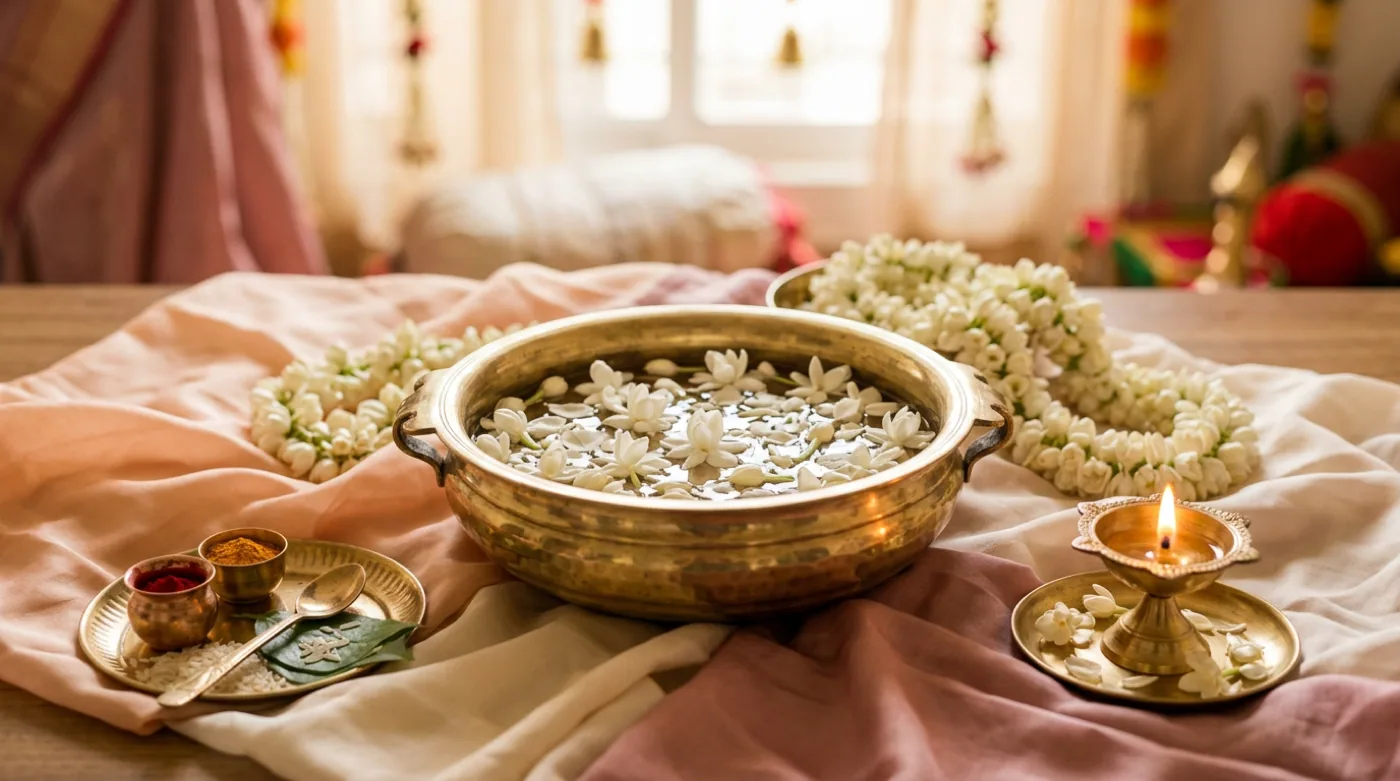
Cleaning the home and puja area, decorating the cradle if the cradle ceremony is combined, arranging puja samagri including a brass thali, rice grains, gold stick, ghee, honey, and flowers.
- Step 2
Ganesh Pooja
The ceremony begins with Ganesh Pooja to remove obstacles. The parents sit together with the baby.
- Step 3
Navagraha and ancestor invocation
Prayers are offered to the nine planetary deities and to the family’s ancestors, formally informing them of the new member and seeking their blessings.
- Step 4
Havan
A small havan (sacred fire ritual) is performed if the family observes the full version, with mantras for the child’s long life and well-being.
- Step 5
Name writing on rice grains
Rice grains are spread on a brass thali. The father uses a gold stick (or his finger) to write the chosen name on the rice while chanting the name of the family deity.
- Step 6
Whispering the name
The father whispers the name into the child’s right ear four times along with a prayer. This is the actual moment of naming.
- Step 7
Family acceptance
Everyone present repeats a few words after the priest to formally accept the name. Elders bless the child and the parents.
- Step 8
Cradle ceremony (often combined)
In many families, the child is then placed in a decorated cradle for the first time as part of the same ceremony — particularly in South Indian traditions.
- Step 9
Feast and gifts
Family and friends share a meal. Gifts for the child are presented; many families specifically give silver items (anklets, bowls, spoons) as Naamkaran gifts.
Regional variations across India
While the core idea — formally naming the child with family witness — is consistent across Hindu India, the specific rituals, regional names, and surrounding traditions vary meaningfully.
Major regional variations
- North India (Punjabi, Haryanvi, UP, Bihar) — typically held on the 11th day or within the first month. Often combined with a havan and family lunch. The kuldevta (family deity) is specifically invoked.
- Maharashtra — known as ‘Barsa’ or Naamkaran; often performed on the 12th day and includes specific cradle ceremony rituals. Lullabies (palna geet) are sung by women of the household.
- Gujarat — ‘Naamkaran’ or ‘Pagla’; often combines the naming with the first cradle placement and includes a specific custom of writing the name in turmeric paste on a wooden plank.
- Bengal — ‘Annaprashan’ traditions sometimes overlap with naming; the formal naming may happen on the 21st day or at the rice-feeding ceremony, depending on family practice.
- Tamil Nadu — ‘Naamakaranam’ or ‘Thotti Tholai’; the cradle ceremony is particularly elaborate, with the cradle decorated with jasmine and the baby placed in it during the ritual.
- Kerala — ‘Namkaranam’; often performed at the family deity’s temple as part of the family’s religious tradition, with the priest officiating at the temple itself.
- Karnataka and Andhra Pradesh — ‘Barasala’ or ‘Naamakaranam’; the 11th day is the most common, with specific rituals around the cradle placement.
- Sindhi and other communities — distinct community variations exist, with names like ‘Naamkaran Sanskar’ or specific community-traditional ceremony names.
Modern adaptations
Most urban Indian families today do a simpler Naamkaran than their grandparents would have done. The core elements — the priest, the name writing, the whispering, the family acceptance, the blessings, the meal — remain, but the duration and elaboration are scaled to fit working schedules, smaller homes, and the mother’s recovery.
Do
- Keep the core ritual moments meaningful — the whispering of the name in the child’s ear is the moment the entire ceremony is built around.
- Plan around the mother’s comfort first — she will be holding the baby through long sections of the ceremony.
- Make the ceremony accessible — short, comfortable seating, breastfeeding privacy, AC if it’s summer.
- Photograph the name-writing moment, the whispering, and the first family blessings — these are the keepsake images.
Do not
- Try to compress a full Naamkaran into 20 minutes — either do a short proper version planned by the priest or do the full version with breaks.
- Make the ceremony so elaborate that the mother is exhausted — the ritual is supposed to bless the family, not strain it.
- Skip the family acceptance moment because it ‘seems redundant’ — it is one of the most emotionally significant parts.
- Treat the social-display side (catering, photographer, decor) as more important than the ritual itself.
Host checklist for Naamkaran
Practical Naamkaran planning
- ✓Priest confirmed for the muhurat (book 1-2 weeks in advance).
- ✓Samagri list from the priest (rice grains, brass thali, gold stick or coin, ghee, honey, sandalwood, agarbatti, ghee lamp, fresh flowers).
- ✓Cradle decorated if a cradle ceremony is being combined.
- ✓Mother and child’s comfortable seating arranged — soft cushions, accessible water.
- ✓Quiet/breastfeeding area available away from the main gathering.
- ✓Photographer or family designated for key ritual moments.
- ✓Light, easily-shareable meal planned — short ceremony often means short meal.
- ✓Silver gift items prepared if family tradition includes giving these to the baby.
- ✓Digital invite shared with map, timing, and ‘intimate gathering’ note.
- ✓RSVP collected — Naamkaran is often kept smaller than other family functions.
Final thoughts
Naamkaran is one of the most quietly moving ceremonies in Hindu family life. It is the moment when a name moves from being something the family thought about into being something the family says — when the syllables become a person. The 11th day, the 12th day, the first month, or the muhurat the priest identifies: the exact timing matters less than the moment of whispering the name into the child’s ear with the people who love them watching. Done with intention, even a short and modest Naamkaran does its work. Done as performance, even an elaborate one feels hollow.
Naamkaran / Baby naming ceremony: what it is (simple)
Naamkaran / Baby naming ceremony details can vary by family and region. Think of this guide as a practical overview so you can plan invitations, timing, and guest communication clearly.
Typical flow (planning-friendly)
- Confirm the muhurat/timing with family or priest (if applicable).
- Decide guest list: family-only vs open invitation.
- Prepare a simple schedule: arrival, main ritual, photos, food, dispersal.
- Share map + parking notes and a single RSVP link/number.
What to write in the invite
- Keep the first line respectful; keep the rest practical (time, map, RSVP).
- If there are multiple sub-events (puja + lunch), list timings separately.
- If you want a quiet/ritual-first vibe, mention it gently.
- If gifts are not needed, a simple “blessings only” line avoids awkwardness.
Invite templates (copy-ready)
- Naamkaran / Baby naming ceremony invitation
- With the blessings of our family, we invite you to join us for [ritual] on [Date] at [Time].
- Venue: [Venue] (Map: [Link])
- RSVP by [Date]: [Link/Number]
Guest comfort notes
- ✓Parking clarity (where to enter, where to park)
- ✓Seating for elders
- ✓Shoes policy (if any)
- ✓Photo moment timing (when to arrive for photos)
- ✓Meal timing so guests can plan
Common questions
- Do we need a dress code? Only if you truly want it—otherwise skip.
- Can we keep it intimate? Yes—say “family-only” clearly and early.
- How to handle late arrivals? Mention ritual start time and request punctuality politely.
What guests usually ask you (prepare answers)
- Exact address + map pin?
- Parking / entry gate?
- When is the main ritual start time?
- Meal timing?
- Is it family-only / kids-friendly?
- What should we bring (if anything)?
What to include (quick checklist)
- ✓Host/couple/family names (as you want them displayed).
- ✓Event name + date + start time (and end time if relevant).
- ✓Venue name + full address + Google Maps link.
- ✓Dress code / theme (only if you truly need it).
- ✓RSVP method + last date (button/link/phone).
- ✓Any special note: kids policy, parking, gifts, footwear, etc.
Copy-ready templates
Short & clear (WhatsApp-friendly)
- Baby naming ceremony for [Name]
- Date: [Day, DD MMM] | Time: [Time]
- Venue: [Venue / Area] (Map: [Link])
- RSVP by [Date]: [RSVP Link/Number]
Warm family tone
- With joy in our hearts, we invite you to join us for Baby naming ceremony of [Name].
- Your blessings and presence will make the day special.
- Details: [Date, Time, Venue]. RSVP: [Link].
Formal tone
- Request the pleasure of your company at the baby naming ceremony of [Name] on [Date] at [Venue].
- Kindly RSVP by [Date] at [Link/Number].
Template bank (mix & match)
- You’re invited to baby naming ceremony of [Name] on [Date] at [Venue]. RSVP: [Link].
- Join us for a joyful baby naming ceremony celebration for [Name].
- Timing: [Time] | Venue: [Address] | Map: [Link]
- RSVP by [Date] (so we can plan food): [Link]
- Dress: Yellow/white (optional) | Comfortable footwear suggested
- Family-only note: “This is an intimate family gathering.”
- Kids note: “Kids are welcome” / “Adults-only event” (choose one)
- Parking note: “Parking available at [spot]. Entry gate: [X].”
- Gift note (optional): “Your presence is our present.”
- If late: “Please arrive by [time] as the main ritual starts on time.”
- For multiple venues: “Please check the venue line for each function.”
- Contact: “[Name] – [phone] for any help.”
- If you’re late: “Please join by [time]; rituals start on time.”
- If you want photos: “Please arrive by [time] for family photos.”
- If venue has multiple gates: “Entry gate: [X]. Please don’t follow old pins.”
- If it’s a home event: “Please use lift/stairs to [floor]. Ring [bell/flat].”
- If it’s a banquet: “Hall: [Name] | Floor: [X].”
- If it’s a destination: “Hotel: [Name] | Check-in: [time] (optional).”
- If you’re doing multiple events: “Full schedule below—save this message.”
Hinglish lines (ready to copy)
- Baby naming ceremony ke liye aapko hardik nimantran! [Date] ko [Time] par [Venue].
- Map: [Link] | RSVP: [Link/Number] | Deadline: [Date]
- Aapki presence se celebration aur special ho jayega.
- Thoda sa jaldi aa jaiye—main ritual time par start hoga.
- Agar aap family ke saath aa rahe ho, headcount RSVP me mention kar dena.
Ultra-short versions (status style)
- Baby naming ceremony: [DD MMM], [Time] — [Venue]. Map: [Link]. RSVP: [Link].
- Baby naming ceremony for [Name] — [DD MMM] [Time]. Venue: [Link].
- Reminder: Baby naming ceremony tomorrow [Time]. Map: [Link].
RSVP lines that work
- Please RSVP by [Date] so we can plan seating and food.
- If you’re coming with family, mention total guests/headcount in RSVP.
- If plans change, just update us—no stress.
- If you’re unsure, reply ‘maybe’ now and confirm by the deadline.
WhatsApp format (recommended)
Most guests skim. A WhatsApp message works best when the key facts are in the first 4–6 lines. Keep emojis minimal and keep the link(s) short.
Example message
- Baby naming ceremony — [Name]
- 📅 [Day, DD MMM] | ⏰ [Time]
- 📍 [Venue, Area] (Map: [Link])
- RSVP by [Date]: [RSVP Link/Number]
- Note: [Parking / dress / kids info if needed]
If you have multiple functions
If Haldi/Mehendi/Sangeet are on different days (or even the same day), list each function as a separate mini-block with its own time + venue. This prevents confusion and reduces last-minute calls.
- Function 1: [Name] — [Date], [Time], [Venue] (Map: [Link])
- Function 2: [Name] — [Date], [Time], [Venue] (Map: [Link])
- RSVP once for all functions: [Link]
Common mistakes to avoid
Do
- Put date/time in a separate line.
- Share a clickable map link (not just a landmark).
- Add RSVP deadline and one clear action.
Do not
- Bury venue details inside a long paragraph.
- Write two different start times in different places.
- Use vague phrases like “evening” without a time.
Helpful links
Keep exploring — invitation hubs
Templates, occasions, and wording — strong paths from this article into the product surface.
FAQs – Baby Naming Ceremony (Naamkaran) Traditions: Rituals, Timing, and Regional Variations in India
When should Naamkaran be performed?
Traditionally on the 11th day for daughters and 12th day for sons. Modern families often delay it to 21 days, 40 days, the 100th day, or up to the first birthday based on the mother’s recovery, the child’s health, travel logistics, and the priest’s muhurat recommendation.
Is the name chosen before the ceremony or at the ceremony?
Almost always before. The family typically consults a priest or astrologer for the nakshatra-aligned starting syllable, then picks the name themselves. The ceremony is the formal moment of giving the chosen name — the choice happens in advance.
What is the role of the nakshatra in naming?
Each of the 27 nakshatras is divided into four charanas, and each charana has associated auspicious starting syllables. Many families use one of these syllables as the starting letter of the child’s name. Some families keep a separate religious nakshatra name from the everyday name.
Can men and outside relatives attend Naamkaran?
Yes — Naamkaran is typically a family-and-close-friends gathering with both men and women. It is more intimate than a wedding but more inclusive than a strictly private rite. The ceremony usually requires the father’s direct participation (whispering the name).
Do all Hindu communities perform Naamkaran the same way?
No. While the core idea — formally naming the child with family witness — is consistent, the specific rituals, regional names, surrounding ceremonies (cradle, ear-piercing), and timing conventions vary meaningfully across regions and communities.
Can Naamkaran be combined with the cradle ceremony?
Yes — particularly in South Indian, Maharashtrian, and Gujarati traditions, the cradle ceremony is often performed on the same day as Naamkaran, with the baby placed in the decorated cradle for the first time as part of the larger ritual.
Should Naamkaran be a big or small function?
Most modern families keep it intimate — close family, a few dear friends, perhaps 20–40 people. The mother is still in recovery and the child is very young, so a smaller, gentler gathering generally serves the moment better than a large celebration.
Kya ye content har family par apply hota hai?
Nahi—India me customs family/community ke hisaab se change hote hain. Isliye is guide ko practical baseline samjho.
Invite ko short kaise rakhein?
Headline + bullets (date/time/venue/RSVP) rakho, aur extra details ko separate section/link me rakho.
Read next
Continue your learning journey with these related guides.
Planning
Godh Bharai Ceremony: Meaning, the Seventh-Month Tradition, and Regional Variations Across India
A complete guide to the Godh Bharai ceremony — its meaning (‘filling the lap’), its roots in the ancient Simantonnayana samskara, the traditional seventh-month timing, the core rituals, and the meaningfully different regional forms — Marathi Dohale Jevan, Tamil Valaikappu / Seemantham, Bengali Sadh, Punjabi traditions, and more.
12 min read
Housewarming
Griha Pravesh Ritual Guide: Meaning, the Three Classical Types, and the Full Ceremony Explained
A complete guide to the Griha Pravesh ceremony — its meaning, the three classical types (Apoorva, Sapoorva, Dwandwa), the central Kalash Pooja and Vastu Shanti rituals, regional variations across India, and how modern families adapt the ceremony for urban homes.
7 min read
Wedding
Indian Wedding Ceremony Guide: Rituals, Meaning, Regional Variations, and Modern Relevance
A practical guide to Indian wedding rituals, regional traditions, family variations, and modern wedding planning.
5 min read
RSVP
RSVP Wording for Indian Invitations: Templates That Actually Get Replies
Carefully written RSVP wording examples for Indian invitations — formal lines for printed cards, warm lines for family WhatsApp groups, urgent lines for caterer deadlines, multi-function lines for multi-day weddings, and the small phrasings that double your reply rate.
5 min read
Planning
What Details Should Every Invitation Include: The Complete Checklist for Indian Events
Ek complete invitation me kuch cheezein mandatory hain, kuch optional, aur kuch situational. Yahaan ek systematic checklist — must-have details, important-but-optional details, multi-day function ke liye special considerations, aur woh small details (parking, kids policy, dress code) jo guest experience ko make-or-break kar dete hain.
10 min read
On this page
- What is Naamkaran?
- Place in the sixteen samskaras
- Why the 11th or 12th day?
- Nakshatra-based naming
- The core ritual flow
- Regional variations
- Modern adaptations
- Host checklist
- Final thoughts
- Typical flow (planning-friendly)
- What to write in the invite
- Invite templates (copy-ready)
- Guest comfort notes
- Common questions
- What guests usually ask you (prepare answers)
- What to include (quick checklist)
- Copy-ready templates
- Template bank (mix & match)
- Hinglish lines (ready to copy)
- Ultra-short versions (status style)
- RSVP lines that work
- WhatsApp format (recommended)
- If you have multiple functions
- Common mistakes to avoid