Godh Bharai Ceremony: Meaning, the Seventh-Month Tradition, and Regional Variations Across India
A complete guide to the Godh Bharai ceremony — its meaning (‘filling the lap’), its roots in the ancient Simantonnayana samskara, the traditional seventh-month timing, the core rituals, and the meaningfully different regional forms — Marathi Dohale Jevan, Tamil Valaikappu / Seemantham, Bengali Sadh, Punjabi traditions, and more.
Key takeaway
Godh Bharai — literally ‘filling the lap’ — is the Indian pregnancy ceremony performed in the seventh month to bless and celebrate the expectant mother. It is the cultural ancestor of the Western baby…
What is Godh Bharai?
Godh Bharai is the traditional Indian pregnancy ceremony at which the expectant mother is blessed by the women of her family and community. The Hindi-Urdu name literally means ‘filling the lap’, and the central ritual is exactly that — the women of the household symbolically fill the seated mother’s lap with fruits, dry fruits, sweets, coins, and small gifts, each item representing a wish for the mother and child: abundance, sweetness, prosperity, health, and a smooth journey through the remaining months of pregnancy.
Unlike a Western baby shower, which is centred primarily on celebrating the impending arrival of the baby with games and gifts, Godh Bharai is centred on the expectant mother herself. The dressing of the mother in new clothes and jewellery, the songs sung to her, the blessings whispered into her ear by elders, the foods cooked specifically to satisfy her cravings — every part of the ceremony is about caring for the woman carrying the new life, not just anticipating the new life itself.
Roots in the Simantonnayana samskara
Godh Bharai’s deeper roots lie in the ancient Hindu samskara called Simantonnayana — one of the sixteen rites of passage and the third in the traditional sequence (after Garbhadhana and Pumsavana). Simantonnayana literally means ‘parting of the hair’, referring to the central traditional ritual in which the husband parts his wife’s hair upwards three times with a specific bunch of darbha grass, durva grass, or a porcupine quill, while reciting Vedic mantras for the protection of mother and child.
What the Simantonnayana tradition emphasised
- Protection of the mother and unborn child during the final phase of pregnancy.
- Mental peace and positive emotional state of the mother — recognised in the tradition as influencing the child.
- Community and family support gathered around the mother before delivery.
- Specific mantras invoking deities associated with childbirth and child wellbeing.
- Often combined with feeding the mother her favourite foods — recognising the importance of satisfying pregnancy cravings.
Why the seventh month?
The seventh month of pregnancy is the traditional timing for Godh Bharai across most Indian communities. Several overlapping reasons explain this:
Why seven months
- Medical safety — by the seventh month, the pregnancy is considered well-established and the risk of early miscarriage has substantially passed.
- Visible pregnancy — the mother’s pregnancy is now clearly visible, which makes the ceremony feel timely and tangible.
- Mother’s mobility — the seventh month is generally before the late-pregnancy physical discomfort makes long ceremonies tiring.
- Buffer before delivery — performing the ceremony in the seventh rather than the ninth month leaves time for the mother to recover and prepare before delivery.
- Astrological considerations — many traditions consider the seventh month auspicious for prenatal ceremonies.
- Cultural avoidance of the eighth month — some traditions specifically avoid the eighth month for major ceremonies for the mother.
Many families also perform Godh Bharai in the ninth month — particularly in some South Indian and Bengali traditions — but the seventh month remains the most common timing across India.
The core rituals
While the specific rituals vary meaningfully by region, most Godh Bharai ceremonies share a core sequence of moments:
Common ritual elements
- Adorning the mother — dressing the expectant mother in new clothes (often a specific colour, varying by region) and traditional jewellery.
- Aarti and welcome — the mother is welcomed into the ceremony space with aarti, often by her mother-in-law or eldest woman of the family.
- Filling the lap — the central ritual: the women of the family place fruits, dry fruits, sweets, coins, and small gifts in the mother’s lap.
- Blessing whispers — elders whisper specific blessings into the mother’s ear, often invoking deities associated with motherhood.
- Songs and traditional music — many regions have specific songs sung at Godh Bharai, often by older women of the family.
- Favourite foods — the mother is fed her favourite foods and pregnancy cravings, recognising the cultural understanding that her cravings should be honoured.
- Bangles and jewellery — in many regions, specific bangles (often glass) are put on the mother’s wrists by the women of the family.
- Family meal — close family share a meal together, often with foods symbolic of fertility and abundance.
Regional variations across India
Godh Bharai takes meaningfully different forms across India. While the central intention is shared — celebrating and blessing the expectant mother — the specific rituals, names, foods, and conventions vary significantly:
Major regional variations
- North India (Punjabi, Haryanvi, UP, Bihar) — known simply as Godh Bharai or Godh Bharna. Performed in the seventh month, often with the mother dressed in red or pink. Emphasis on filling the lap with fruits and sweets, and feeding the mother her favourite foods.
- Maharashtra — Dohale Jevan (literally ‘feast for cravings’). The focus is specifically on satisfying the expectant mother’s pregnancy cravings — the family asks her what she wants to eat and prepares those foods. The ceremony is typically held in the seventh or ninth month.
- Tamil Nadu — Valaikappu and Seemantham. Valaikappu is the bangle ceremony, where the mother is adorned with red and green glass bangles, and a specific black saree is worn to ward off negative energies. Seemantham is the broader prenatal ceremony of which Valaikappu is part. Both are typically held in the seventh or ninth month.
- Andhra Pradesh and Karnataka — Seemantham (the same Sanskrit-derived term as in Tamil Nadu), with similar bangle and adornment traditions but distinct community-specific variations.
- Kerala — Pulikudi or Vaalaikappu in some communities; the ceremony often includes the giving of a specific herbal drink (tamarind-based pulikudi) to the mother.
- Bengal — Sadh or Sadhbhokkhon. Performed in the seventh month, the mother is given her favourite foods and dressed in new clothes. The name ‘sadh’ literally references the mother’s wishes and cravings being fulfilled.
- Gujarat — Khodo Bharvo or Simant. The lap-filling ritual is central, with specific Gujarati foods served.
- Sindhi community — Aatha specifically refers to the seventh-month ceremony, with community-specific songs and ritual elements.
- Punjabi tradition — alongside Godh Bharai itself, some Punjabi families perform a related ceremony with specific bhangra elements and the giving of bracelets and gold to the expectant mother.
Modern adaptations
Most urban Indian families today combine traditional Godh Bharai with Western baby-shower elements — games, themed decor, gift registries, and mixed-gender attendance. The core lap-filling moment and the blessing of the mother are usually preserved, but the surrounding ceremony is often updated for modern sensibilities.
Do
- Keep the mother comfortable as the absolute first priority — long seated rituals can be physically taxing in the seventh month.
- Honour the regional tradition specifically if the family has one — Dohale Jevan is meaningfully different from Sadh, and conflating them flattens both.
- Ask the mother what foods she actually wants — the cravings-fulfilment aspect of the tradition is meaningful, not symbolic.
- Include men in the celebration if that suits the family — modern Godh Bharai is increasingly mixed-gender, even though traditional forms were women-centric.
- Keep the gift expectations clear in advance — modern families often prefer practical baby items over symbolic ones.
Do not
- Schedule the ceremony in the eighth month — most traditions specifically avoid this period.
- Treat Godh Bharai as identical to a Western baby shower — the cultural emphases are different, and assuming they’re the same can feel dismissive of the tradition.
- Make the ceremony so long that the mother is exhausted — short and warm beats long and elaborate.
- Force-fit a single regional tradition onto a family from a different region — let each family observe their own.
Host planning checklist
Practical Godh Bharai planning
- ✓Mother’s comfort considerations — soft cushioned seating, AC if summer, accessible bathroom.
- ✓Mother’s outfit — typically new clothes in the family’s preferred regional colours.
- ✓Lap-filling items — fruits (especially seasonal), dry fruits, sweets, coins, small symbolic gifts.
- ✓Bangles if regional tradition includes the bangle-giving moment.
- ✓The mother’s favourite foods — actually ask her in advance, this is meaningful in many traditions.
- ✓Traditional songs — printed lyrics for younger family members if regional songs are part of the tradition.
- ✓Photographer or family member designated for the lap-filling moment.
- ✓Light, easy-to-eat menu — pregnancy makes some foods less appealing.
- ✓Quiet area for the mother to rest before and after the main rituals.
- ✓Digital invite with the regional name of the ceremony, dress code if any, and ‘intimate family’ framing.
Final thoughts
Godh Bharai is one of the most quietly beautiful ceremonies in Indian family life — a moment when the women of a family gather not to celebrate a milestone reached but to bless a journey still being walked. The lap is filled not as a metaphor but as a literal gesture of support; the favourite foods are served not as performance but as care; the blessings are whispered not for the baby but for the mother who is carrying them. Whether your family calls it Godh Bharai, Dohale Jevan, Valaikappu, Seemantham, Sadh, or any of the other regional names — what makes it meaningful is the gathering of women around a woman, telling her that she will not walk this last stretch alone.
Godh Bharai: what it is (simple)
Godh Bharai details can vary by family and region. Think of this guide as a practical overview so you can plan invitations, timing, and guest communication clearly.
Typical flow (planning-friendly)
- Confirm the muhurat/timing with family or priest (if applicable).
- Decide guest list: family-only vs open invitation.
- Prepare a simple schedule: arrival, main ritual, photos, food, dispersal.
- Share map + parking notes and a single RSVP link/number.
What to write in the invite
- Keep the first line respectful; keep the rest practical (time, map, RSVP).
- If there are multiple sub-events (puja + lunch), list timings separately.
- If you want a quiet/ritual-first vibe, mention it gently.
- If gifts are not needed, a simple “blessings only” line avoids awkwardness.
Invite templates (copy-ready)
- Godh Bharai invitation
- With the blessings of our family, we invite you to join us for [ritual] on [Date] at [Time].
- Venue: [Venue] (Map: [Link])
- RSVP by [Date]: [Link/Number]
Guest comfort notes
- ✓Parking clarity (where to enter, where to park)
- ✓Seating for elders
- ✓Shoes policy (if any)
- ✓Photo moment timing (when to arrive for photos)
- ✓Meal timing so guests can plan
Common questions
- Do we need a dress code? Only if you truly want it—otherwise skip.
- Can we keep it intimate? Yes—say “family-only” clearly and early.
- How to handle late arrivals? Mention ritual start time and request punctuality politely.
What guests usually ask you (prepare answers)
- Exact address + map pin?
- Parking / entry gate?
- When is the main ritual start time?
- Meal timing?
- Is it family-only / kids-friendly?
- What should we bring (if anything)?
What to include (quick checklist)
- ✓Host/couple/family names (as you want them displayed).
- ✓Event name + date + start time (and end time if relevant).
- ✓Venue name + full address + Google Maps link.
- ✓Dress code / theme (only if you truly need it).
- ✓RSVP method + last date (button/link/phone).
- ✓Any special note: kids policy, parking, gifts, footwear, etc.
Copy-ready templates
Short & clear (WhatsApp-friendly)
- Godh Bharai for [Name]
- Date: [Day, DD MMM] | Time: [Time]
- Venue: [Venue / Area] (Map: [Link])
- RSVP by [Date]: [RSVP Link/Number]
Warm family tone
- With joy in our hearts, we invite you to join us for Godh Bharai of [Name].
- Your blessings and presence will make the day special.
- Details: [Date, Time, Venue]. RSVP: [Link].
Formal tone
- Request the pleasure of your company at the godh bharai of [Name] on [Date] at [Venue].
- Kindly RSVP by [Date] at [Link/Number].
Template bank (mix & match)
- You’re invited to godh bharai of [Name] on [Date] at [Venue]. RSVP: [Link].
- Join us for a joyful godh bharai celebration for [Name].
- Timing: [Time] | Venue: [Address] | Map: [Link]
- RSVP by [Date] (so we can plan food): [Link]
- Dress: Yellow/white (optional) | Comfortable footwear suggested
- Family-only note: “This is an intimate family gathering.”
- Kids note: “Kids are welcome” / “Adults-only event” (choose one)
- Parking note: “Parking available at [spot]. Entry gate: [X].”
- Gift note (optional): “Your presence is our present.”
- If late: “Please arrive by [time] as the main ritual starts on time.”
- For multiple venues: “Please check the venue line for each function.”
- Contact: “[Name] – [phone] for any help.”
- If you’re late: “Please join by [time]; rituals start on time.”
- If you want photos: “Please arrive by [time] for family photos.”
- If venue has multiple gates: “Entry gate: [X]. Please don’t follow old pins.”
- If it’s a home event: “Please use lift/stairs to [floor]. Ring [bell/flat].”
- If it’s a banquet: “Hall: [Name] | Floor: [X].”
- If it’s a destination: “Hotel: [Name] | Check-in: [time] (optional).”
- If you’re doing multiple events: “Full schedule below—save this message.”
Hinglish lines (ready to copy)
- Godh Bharai ke liye aapko hardik nimantran! [Date] ko [Time] par [Venue].
- Map: [Link] | RSVP: [Link/Number] | Deadline: [Date]
- Aapki presence se celebration aur special ho jayega.
- Thoda sa jaldi aa jaiye—main ritual time par start hoga.
- Agar aap family ke saath aa rahe ho, headcount RSVP me mention kar dena.
Ultra-short versions (status style)
- Godh Bharai: [DD MMM], [Time] — [Venue]. Map: [Link]. RSVP: [Link].
- Godh Bharai for [Name] — [DD MMM] [Time]. Venue: [Link].
- Reminder: Godh Bharai tomorrow [Time]. Map: [Link].
RSVP lines that work
- Please RSVP by [Date] so we can plan seating and food.
- If you’re coming with family, mention total guests/headcount in RSVP.
- If plans change, just update us—no stress.
- If you’re unsure, reply ‘maybe’ now and confirm by the deadline.
WhatsApp format (recommended)
Most guests skim. A WhatsApp message works best when the key facts are in the first 4–6 lines. Keep emojis minimal and keep the link(s) short.
Example message
- Godh Bharai — [Name]
- 📅 [Day, DD MMM] | ⏰ [Time]
- 📍 [Venue, Area] (Map: [Link])
- RSVP by [Date]: [RSVP Link/Number]
- Note: [Parking / dress / kids info if needed]
If you have multiple functions
If Haldi/Mehendi/Sangeet are on different days (or even the same day), list each function as a separate mini-block with its own time + venue. This prevents confusion and reduces last-minute calls.
- Function 1: [Name] — [Date], [Time], [Venue] (Map: [Link])
- Function 2: [Name] — [Date], [Time], [Venue] (Map: [Link])
- RSVP once for all functions: [Link]
Common mistakes to avoid
Do
- Put date/time in a separate line.
- Share a clickable map link (not just a landmark).
- Add RSVP deadline and one clear action.
Do not
- Bury venue details inside a long paragraph.
- Write two different start times in different places.
- Use vague phrases like “evening” without a time.
Helpful links
Keep exploring — invitation hubs
Templates, occasions, and wording — strong paths from this article into the product surface.
FAQs – Godh Bharai Ceremony: Meaning, the Seventh-Month Tradition, and Regional Variations Across India
Is Godh Bharai the same as a Western baby shower?
Not exactly. Both celebrate impending birth, but the emphases differ — Godh Bharai centres on the expectant mother (her comfort, her cravings, her blessings), while the Western baby shower centres more on the baby-to-be (gifts, games, gender reveals). Many modern Indian families combine elements of both.
What is the difference between Godh Bharai and Simantonnayana?
Simantonnayana is the ancient Vedic samskara — one of the sixteen Hindu rites of passage — performed in the seventh or eighth month with specific mantras and the symbolic parting of the wife’s hair by the husband. Godh Bharai is the modern, community-centred descendant of this tradition, with the focus shifted from the husband-led ritual to the women of the family gathering around the mother.
Should Godh Bharai be in the seventh month or the ninth month?
Most traditions favour the seventh month. Some South Indian and Bengali families use the ninth month. Most traditions specifically avoid the eighth month. The right month for your family depends on regional tradition, the mother’s health, and the priest’s recommendation if astrology is consulted.
Can men attend Godh Bharai?
Traditionally Godh Bharai was a women-centric ceremony. Modern families often hold mixed-gender celebrations, particularly when the surrounding format includes a meal and gift-giving. If the central rituals are being performed traditionally, the women-only convention is often maintained for those rituals specifically, with men joining for the meal.
What is Dohale Jevan and how is it different from Godh Bharai?
Dohale Jevan is the Marathi equivalent of Godh Bharai. The central difference is the specific emphasis on satisfying the expectant mother’s pregnancy cravings — the family asks her what foods she wants and prepares them. The rest of the ceremony (blessings, gifts, family gathering) is similar in intent.
What is Valaikappu and Seemantham?
Valaikappu is the Tamil bangle ceremony, in which the expectant mother is adorned with red and green glass bangles by the women of her family. Seemantham is the broader Tamil prenatal ceremony of which Valaikappu is part. Both are typically held in the seventh or ninth month and are the South Indian Hindu equivalents of Godh Bharai.
Can Godh Bharai be a small, intimate gathering?
Yes — many families specifically prefer it that way. The traditional form is family-and-close-friends, often 15–30 women. A large public Godh Bharai is a modern adaptation; the intimate form is the older convention.
Kya ye content har family par apply hota hai?
Nahi—India me customs family/community ke hisaab se change hote hain. Isliye is guide ko practical baseline samjho.
Invite ko short kaise rakhein?
Headline + bullets (date/time/venue/RSVP) rakho, aur extra details ko separate section/link me rakho.
Read next
Continue your learning journey with these related guides.
Planning
Baby Naming Ceremony (Naamkaran) Traditions: Rituals, Timing, and Regional Variations in India
A complete guide to the Hindu baby naming ceremony — Naamkaran’s place in the sixteen samskaras, the traditional 11th/12th day timing, the role of nakshatra-based naming, the core rituals, regional variations across India, and how modern families adapt the ceremony.
11 min read
Housewarming
Griha Pravesh Ritual Guide: Meaning, the Three Classical Types, and the Full Ceremony Explained
A complete guide to the Griha Pravesh ceremony — its meaning, the three classical types (Apoorva, Sapoorva, Dwandwa), the central Kalash Pooja and Vastu Shanti rituals, regional variations across India, and how modern families adapt the ceremony for urban homes.
7 min read
Wedding
Indian Wedding Ceremony Guide: Rituals, Meaning, Regional Variations, and Modern Relevance
A practical guide to Indian wedding rituals, regional traditions, family variations, and modern wedding planning.
5 min read
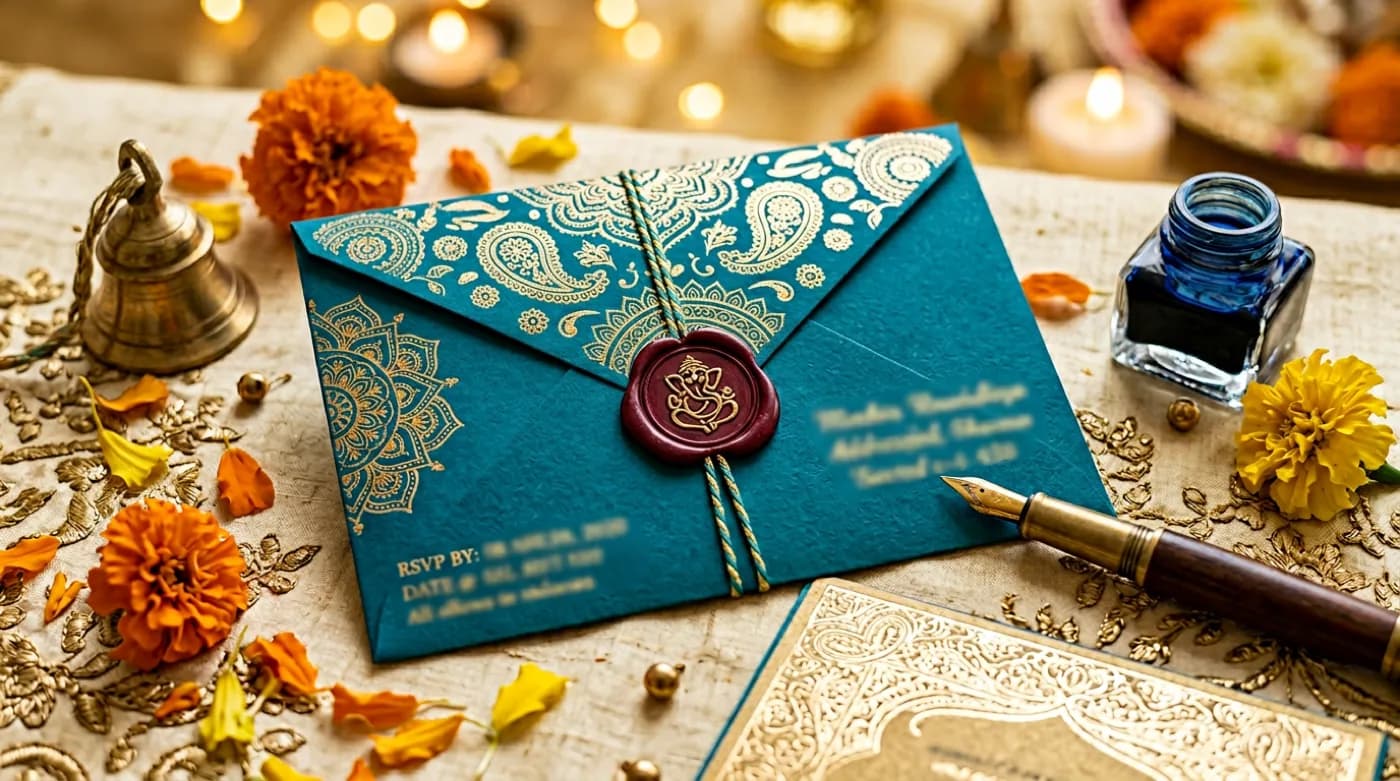
RSVP
RSVP Wording for Indian Invitations: Templates That Actually Get Replies
Carefully written RSVP wording examples for Indian invitations — formal lines for printed cards, warm lines for family WhatsApp groups, urgent lines for caterer deadlines, multi-function lines for multi-day weddings, and the small phrasings that double your reply rate.
5 min read
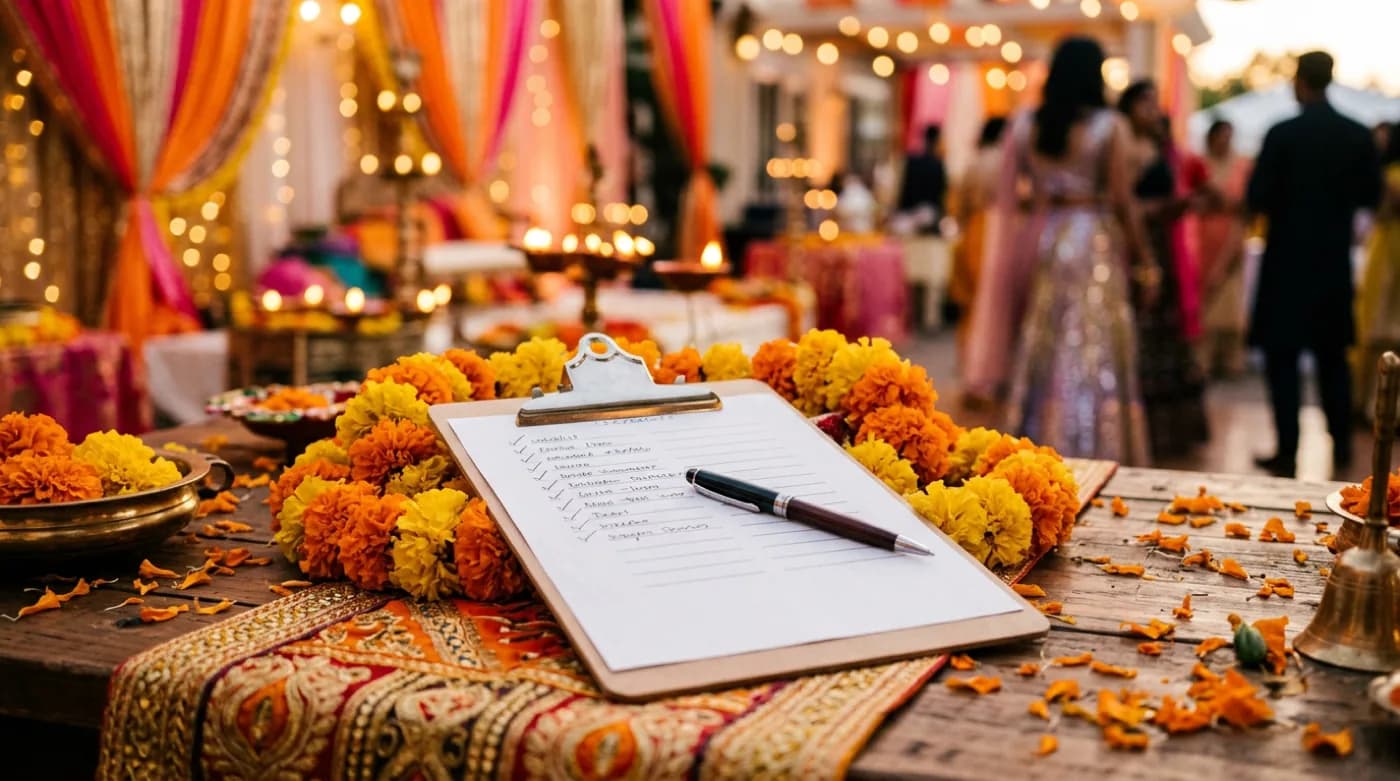
Planning
What Details Should Every Invitation Include: The Complete Checklist for Indian Events
Ek complete invitation me kuch cheezein mandatory hain, kuch optional, aur kuch situational. Yahaan ek systematic checklist — must-have details, important-but-optional details, multi-day function ke liye special considerations, aur woh small details (parking, kids policy, dress code) jo guest experience ko make-or-break kar dete hain.
10 min read
On this page
- What is Godh Bharai?
- Roots in Simantonnayana
- Why the seventh month?
- The core rituals
- Regional variations
- Modern adaptations
- Host planning checklist
- Final thoughts
- Typical flow (planning-friendly)
- What to write in the invite
- Invite templates (copy-ready)
- Guest comfort notes
- Common questions
- What guests usually ask you (prepare answers)
- What to include (quick checklist)
- Copy-ready templates
- Template bank (mix & match)
- Hinglish lines (ready to copy)
- Ultra-short versions (status style)
- RSVP lines that work
- WhatsApp format (recommended)
- If you have multiple functions
- Common mistakes to avoid