



Unique Rituals in Haryana Weddings: What Stands Out
A practical guide to the most distinctive Haryana wedding rituals and what guests should know before attending.
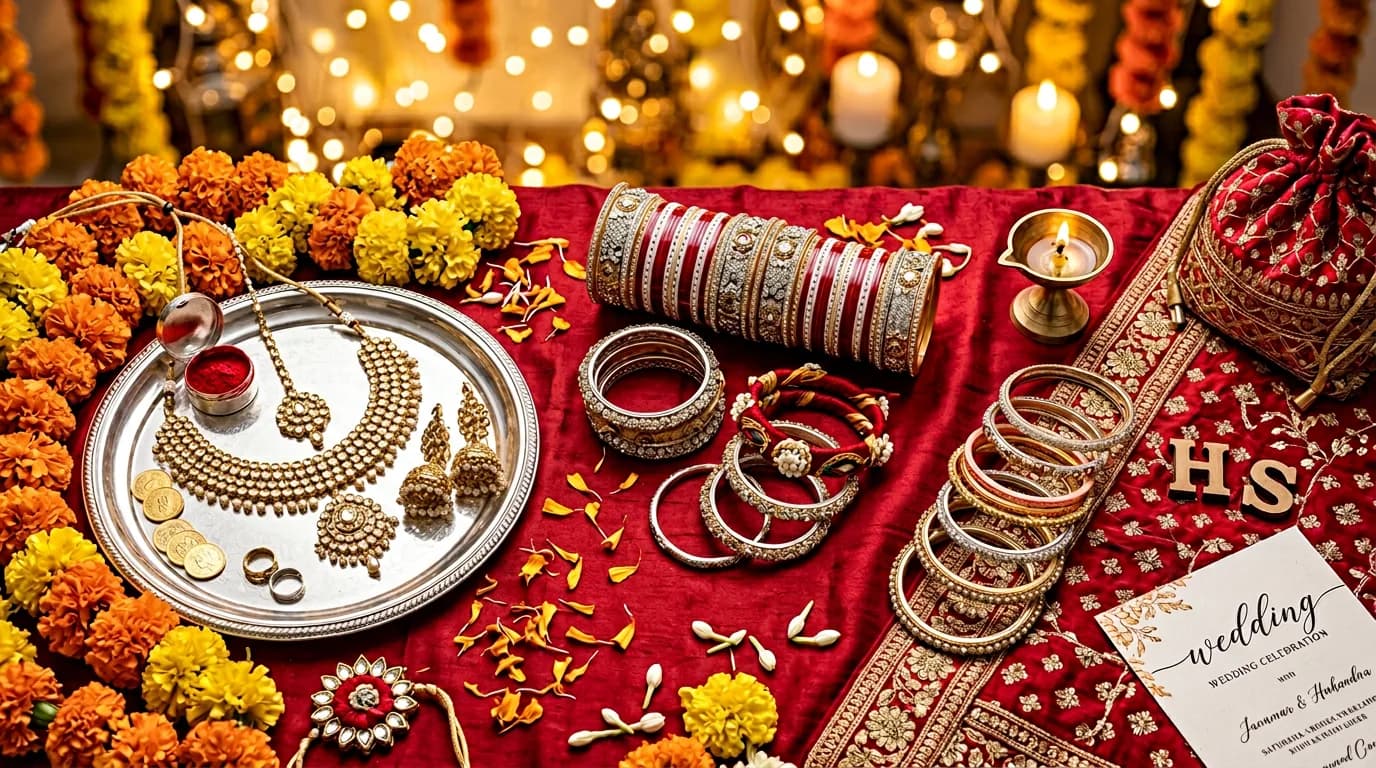
Key takeaway
Haryana weddings are known for high family participation and rituals that carry strong social and cultural meaning. While many North Indian weddings share a common sacred core, some customs in Haryana…
Quick answer
In many Haryana weddings, the most distinctive rituals discussed by families are Ban Baithana, Bhat Niyotna, Ratijga, and the public-family style around Ghudchadhi and Milni. The core sacred rites may look familiar across North India, but local sequencing and social participation make the experience feel different.
What makes these rituals stand out
Regional signature signals
Tap any card to reveal what makes Haryana weddings feel locally distinct.
Tap or hover
Signature rituals at a glance
Switch between rituals
Quick switch
Ban Baithana
Pre-wedding family preparation phase.
Ban Baithana marks the household's transition into wedding mode with grooming, blessings and a focused family gathering before larger guest events begin.
- Lock a family-only time slot before guest-heavy functions begin.
- Set a small ritual area with puja essentials, elder seating and good light.
- Open with elder blessings and follow with traditional grooming/applications.
- Close with a family meal and announce the next function timing clearly.
Bhat Niyotna
Honoring maternal-side participation.
Bhat Niyotna recognizes the formal role of the bride's or groom's maternal family with named introductions and ritual exchange.
- Confirm maternal-side names, arrivals and ceremonial roles in advance.
- Keep ritual exchange items and honoring sequence ready before guests gather.
- Run one consolidated ceremonial window instead of scattered exchanges.
- Share a thank-you note + next-event timing right after the function.
Ratijga
Songs, participation and night energy.
Ratijga is remembered for traditional songs and a family-led celebration block that builds the wedding's social identity.
- Set a clear start-end window and communicate noise boundaries.
- Structure the night into welcome, participation and closing blocks.
- Assign one anchor for announcements and family acknowledgements.
- Plan elders' seating and snacks in the same zone as the main floor.
Ghudchadhi + Milni
Elder-led welcome and public-family exchange.
Haryana families often present Ghudchadhi and Milni with stronger elder-led ceremony and a structured welcome introduction before sacred rites.
- Map baraat arrival route and greeting point on the invite page.
- Pre-decide an elder-first Milni order with named family reps.
- Coordinate photo/video so ritual pace is not interrupted.
- Move from welcome exchange to the next sacred rite without long drift.
Do
- Hosts should map function ownership (maternal/paternal side) in one invite flow.
- Guests should expect timeline shifts and keep arrival buffer.
Do not
- Do not assume every family follows identical sequence.
- Do not merge all functions into one generic event card without ritual context.
Guest etiquette and planning checklist
Walk through guest etiquette in order
Scroll through the steps; the active one stays highlighted as you go.
- Step 1
Read each function's note
Open the invite per ritual to confirm name, attire expectation and start window before reaching out to hosts.
- Step 2
Arrive early for blessing rites
Introductions and blessings move quickly; arriving 15-20 minutes early keeps sacred timing intact.
- Step 3
Follow host-side movement cues
Photography, sitting and movement around sacred steps should match host instructions to avoid breaking pace.
- Step 4
Handle shagun with family guidance
Coordinate gifts and shagun directly with the host's named coordinator instead of routing through multiple people.
Invitation wording ideas for Haryana weddings
High-clarity invite structure
- List each ritual block separately instead of one combined timeline.
- Mention host family line for each function when useful.
- Add one guidance line for guests (arrival buffer, attire, or ceremony decorum).
- Use one RSVP destination across all events to avoid split confirmations.
For a detailed page, use this sequence: Ritual name -> Why this ritual matters -> Start window -> Venue pin -> Host contact -> Dress/etiquette note. This structure reduces guest confusion dramatically.
Interactive planner and engagement tools
Unlock ritual insights
Start with the first two insights, then unlock the rest as you progress.
Family-led sequencing
Named elder roles reduce confusion and keep flow formal.
Maternal-side identity
Bhat windows preserve lineage respect and social balance.
Choose your family style
Switch scenarios to see how planning priorities change.
Traditional
Elder-led format with deeper ritual windows.
- Longer blessing windows
- Named ritual anchors
- Stricter sequence order
60-second ritual fit quiz
Answer two quick questions to get a planning style recommendation.
Your style
Speed-first plan
Prioritize concise notes, quick movement, one host channel.
Build your wedding flow
Select rituals to auto-build a practical ceremony sequence.
- Ban Baithana
- Bhat Niyotna
Try this now (2-minute actions)
Finalize arrival buffer
Pick one buffer for all blessing-heavy events.
Lock one RSVP source
Avoid split confirmations across calls and chats.
End challenge: create your 4-step ceremony plan
Complete this checklist before sending your invitation.
- Choose final ritual sequence
- Assign function owner per ritual
- Write one etiquette line for guests
- Confirm one RSVP destination
Progress: 0/4
Helpful links
Keep exploring — invitation hubs
Templates, occasions, and wording — strong paths from this article into the product surface.
FAQs – Unique Rituals in Haryana Weddings: What Stands Out
Is Ban Baithana done in every Haryana wedding?
Not always. It depends on family tradition, locality, and how traditional the wedding format is.
Why is Bhat Niyotna important?
It honors maternal-side participation and formal family roles before wedding-day ceremonies.
What is Ratijga in simple terms?
It is a night celebration format with songs, community presence, and family participation.
Can modern Haryana weddings simplify these rituals?
Yes, many families keep the essence while reducing ceremony duration and complexity.
Read next
Continue your learning journey with these related guides.
Wedding
Haryanvi Wedding Traditions Explained
A detailed guide to Haryanvi wedding traditions, including common customs, symbolism, family meaning, and modern celebration style.
9 min read
Wedding
Punjabi Wedding Traditions Explained
A detailed guide to Punjabi wedding traditions, including common rituals, family meaning, Sikh and Hindu differences, and modern celebration style.
9 min read
Wedding
UP Hindu Wedding Traditions Explained
A detailed guide to UP Hindu wedding traditions, including common customs, symbolism, family meaning, and modern celebration style.
9 min read
Wedding
Unique Rituals and Social Layers in UP Hindu Weddings
Beyond the mandap core: Tilak days, eastern UP Matkor customs, ladies sangeet energy, baraat welcome pacing, and regional nuance across Purvanchal, Awadh, Braj, and western UP.
2 min read