
Unique Rituals and Social Layers in UP Hindu Weddings
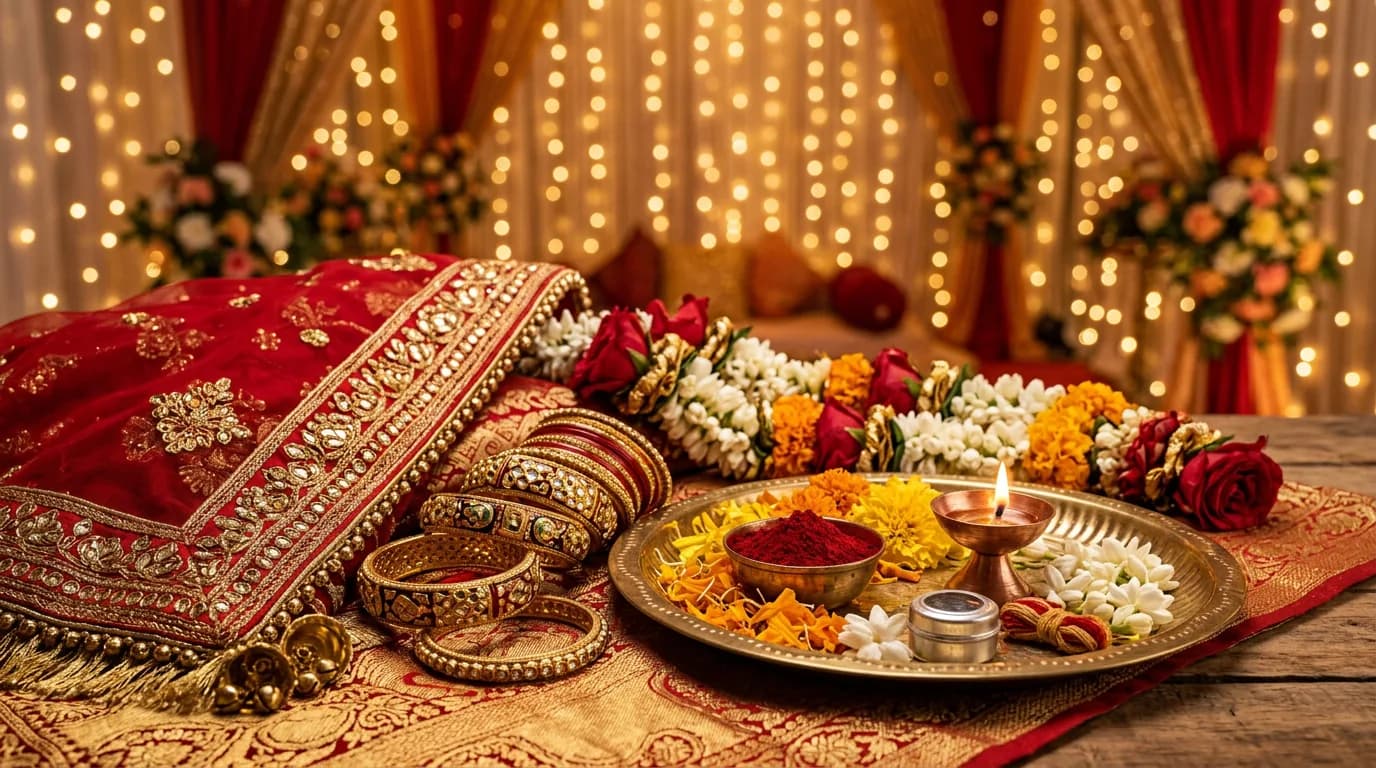
Beyond the mandap core: Tilak days, eastern UP Matkor customs, ladies sangeet energy, baraat welcome pacing, and regional nuance across Purvanchal, Awadh, Braj, and western UP.
Key takeaway
Uttar Pradesh weddings often feel familiar to North Indian guests, yet the standout moments are frequently social and regional: how Tilak is staged, whether Matkor appears, how long the women-led song…
Quick answer
Many Uttar Pradesh Hindu weddings layer a familiar North Indian sacred core with customs that feel especially visible to guests: formal Tilak or sagai-style alliance days, strong women-led song nights, choreographed baraat welcome and garland exchange, and—in eastern pockets—maternal-uncle rituals such as Matkor. None of this is one statewide script; always confirm with the hosts.
Why these customs stand out
UP is large and internally diverse. What feels “unique” is often the combination of high elder involvement, multi-day social pacing, and regional flavour from Purvanchal, Awadh, Braj, or western UP rather than a single ritual name every family performs.
What guests notice first
Tap a card to read the social layer behind the spectacle.
Tap or hover
Signature rituals at a glance
Switch between chapters
Quick switch
Tilak & sagai-style days
Formal groom-side reception and alliance staging.
In many UP households, Tilak marks the groom’s side being formally received and blessed, sometimes with gift exchange and visible respect cues. Some families fold in a ring or sagai on the same day or nearby; others split events. The emotional job is the same: move the match from private agreement to a socially witnessed alliance.
- Publish who leads each gesture so photographers do not crowd elders.
- Separate family-only blessing windows from open-guest segments if needed.
- State dress expectation; Tilak days are often photographed heavily.
- If multiple cities are involved, put pins and reporting times on one page.
Matkor & maternal honouring
Eastern UP / Bhojpuri-influenced belt; not statewide.
Matkor (and similar mausa / maternal-uncle customs) appears in many families linked to eastern UP and Bhojpuri-influenced practice. It is not universal statewide. When it happens, it foregrounds the mother’s brother line with gifts, blessing, or procession elements guests remember. Families in Awadh, Braj, or western UP may emphasise different pre-wedding markers—treat Matkor as regional.
- Ask for the exact local name; households vary.
- Expect gift or thali logistics; arrive when the anchor elder asks.
- Photography: confirm when flash is discouraged around elders.
Ladies sangeet & mehndi
Song-heavy nights and household glue.
Mehndi and ladies sangeet nights often carry strong UP identity through folk-style songs, teasing between sides, and dense female kin participation. They are social glue: guests learn who belongs to which household without a formal programme.
- Share start and hard-stop times; neighbours matter in dense towns.
- One MC or anchor reduces overlapping announcements.
- Reserve seating for elders near good sightlines, not only the dance floor.
Baraat welcome & jaimala
Welcome line to mandap transition.
The groom’s arrival is often staged: welcome line, possible milni-style introductions in western-influenced families, then jaimala or varmala before seating for fire rites. The distinctive feel is pacing—elders visible, avoiding a crush at the gate.
- Hang back until the welcome line clears; do not block the groom’s path.
- Follow ushers for seating; sacred segments need quiet phones.
- If unsure when to garland or bless, wait for the anchor elder’s cue.
Regional variation inside UP
Use this as orientation, not a rulebook. Purvanchal may show stronger Bhojpuri-linked customs; Awadh cities may lean formal; Braj areas may weave local folk flavour; western UP may borrow Punjabi–Haryana welcome habits. Two families in the same city can still differ.
Regional hints (tap to expand)
Purvanchal / east
Check for Matkor-like maternal honouring and song-heavy traditions; naming varies by household.
Awadh
Often emphasises polite formality and elder-first sequencing in public moments.
Braj
Some communities add folk or deity-linked touches in songs or processions—not universal.
Western UP
Influenced households may show milni or kaleera-style moments alongside North Indian core rites.
Hosts and guests: reduce confusion
Do
- Publish a side-wise or day-wise schedule with one RSVP link.
- Name a contact per function for shagun and logistics questions.
- Add one sentence per ritual for out-of-town guests.
Do not
- Do not promise a fixed statewide order you cannot defend.
- Do not merge unrelated functions into one vague card without timings.
Digital invite and event page structure
High-clarity page outline
- Function name and date.
- Why it matters in one plain sentence.
- Host anchor and contact.
- Arrival buffer note for blessing-heavy slots.
Closing thought
UP weddings feel distinctive when families communicate regional nuance honestly and guests respond with punctuality and calm movement around sacred moments. Pair tradition with clear digital scheduling and everyone gets the same respect the rituals are meant to show.
Helpful links
Keep exploring — invitation hubs
Templates, occasions, and wording — strong paths from this article into the product surface.
FAQs – Unique Rituals and Social Layers in UP Hindu Weddings
Is Matkor part of every UP wedding?
No. It is associated with many families in eastern UP and adjacent cultural belts, not a statewide requirement.
Is Tilak mandatory?
Many UP families treat Tilak or a similar formal day as central, but format and naming differ. Ask the hosts.
Do western UP weddings look like Punjabi weddings?
Some families borrow welcome or garland customs; others stay closer to a generic North Indian flow. Do not assume.
How should hosts help out-of-state guests?
Publish timings, venue pins, dress notes, and one plain-language sentence per function on a single event page.
Read next
Continue your learning journey with these related guides.
Wedding
UP Hindu Wedding Traditions Explained
A detailed guide to UP Hindu wedding traditions, including common customs, symbolism, family meaning, and modern celebration style.
9 min read
Wedding
Unique Rituals in Haryana Weddings: What Stands Out
A practical guide to the most distinctive Haryana wedding rituals and what guests should know before attending.
2 min read
Wedding
Bihari Wedding Traditions Explained
A detailed guide to Bihari wedding traditions, including common customs, symbolism, family meaning, and modern celebration style.
9 min read