Printed Card vs Digital Invitation: The Honest Comparison for Modern Indian Weddings
Printed wedding cards have centuries of cultural weight; digital invitations have practical reach, real-time RSVP, and map links. Neither is universally better — the right choice depends on guest demographics, function type, and the role the invitation plays. A clear-eyed comparison across cost, reach, RSVP, elder reception, keepsake value, and the hybrid approach most modern Indian weddings actually use.
Key takeaway
Pichhle das saalon me Indian wedding invitations ka format meaningfully shift hua hai. Jo cheez 2010 me almost universally printed cards thi, ab 2026 me ek hybrid landscape ban gayi hai — kaafi famili…
Printed cards ka cultural weight
Indian shaadi me printed card sirf ek information delivery mechanism nahi hai — woh ek ceremonial object hai. Card ka design family ki taste aur status ka signal hai; uska delivery (haath se diya gaya, kaagaz me lapeta hua, kabhi mithai ke saath) ek meaningful gesture hai. Buzurg generation me, ek printed card receive karna ek formal acknowledgment hai ki ‘aap hamare khaas mehman ho, aapko humne special treat ke saath invite kiya hai’. Yeh weight digital invite me naturally aana mushkil hai, chahe design kitna bhi premium ho.
Iss cultural weight ki vajah se printed card kuch specific situations me abhi bhi non-negotiable hain — guru-jan ke liye, panditji ke liye, hometown ke senior community members ke liye, aur business relationships me jahan formality crucial hai. Inhe digital invite bhejna ek tarah ka unintended slight ho sakta hai, jisko aapka relationship handle nahi kar paaye.
Digital invitations ka practical superiority
Doosri taraf, digital invitations practical planning ke har dimension par win karte hain. Ek shaadi me typically 500-1000 guests hote hain across multiple cities aur countries. Inhe printed cards physically deliver karna ek logistical challenge hai — courier costs, lost packages, late deliveries, returned shipments. Digital invite ek hi WhatsApp message me 1000 logon tak reach ho jaata hai, with embedded map, RSVP button, dietary preference form, aur dress code information.
Digital invitations ke practical advantages
- Instant delivery — WhatsApp, email, SMS, ya direct link share ke through.
- Embedded map — guest ek tap me Google Maps me venue khol sakta hai.
- Structured RSVP — yes/no/maybe + headcount + dietary, sab capture ho jaata hai.
- Real-time updates — agar venue badle ya timing change ho, ek single update se sab guests ko nayi information mil jaati hai.
- Multi-function support — mehendi, haldi, sangeet, wedding, reception — sab ek hi link me organized.
- Bilingual support — Hindi aur English dono versions ek hi link me, language toggle ke saath.
- Analytics — kitne logon ne dekha, kitnon ne RSVP kiya, kis function par interest zyada hai.
- Reminders — automated reminders deadline se pehle, event ke 24 ghante pehle.
- No reprint cost — agar koi detail miss ho gayi ho, free me edit kar sakte hain.
- Environmental impact — paper, ink, courier emissions kaafi kam.
Cost ka real comparison
Cost analysis dono options ka aksar misunderstood hota hai. Log printed card ka per-unit cost dekhke decide karte hain, par hidden costs miss kar dete hain. Yahan ek 500-guest wedding ka realistic cost breakdown hai dono options ke liye:
| Cost component | Printed cards (500 guests) | Digital invitation |
|---|---|---|
| Design / template | ₹5,000-25,000 (one-time) | Included in platform |
| Per-unit / platform cost | ₹100-300 per card × 500 = ₹50,000-1.5L | ₹500-5,000 (one-time platform fee) |
| Delivery / courier | ₹50-200 per card × 500 = ₹25k-1L | ₹0 (WhatsApp/email) |
| Lost / reprint | ₹5,000-15,000 (typical) | ₹0 |
| Time investment | 30-50 hours coordination | 5-10 hours setup + maintain |
| Total | ₹85,000-2,90,000 | ₹500-5,000 |
Pros and cons honest breakdown
Pros
- Printed cards — Ceremonial weight aur permanent keepsake value.
- Printed cards — Elder respect aur tactile beauty jo digital match nahi kar paata.
- Printed cards — No tech barrier; har generation comfortable hai card receive karne me.
- Printed cards — Family heirloom potential; decades tak rakhe ja sakte hain.
- Printed cards — Traditional auspicious symbolism (kalash, swastika, mantras printed).
- Digital invitations — Instant delivery via WhatsApp/email/SMS.
- Digital invitations — Embedded map aur structured RSVP capture.
- Digital invitations — Real-time updates without reprint cost.
- Digital invitations — Low cost aur scalable to 1000+ guests.
- Digital invitations — Multi-function support aur bilingual flexibility.
- Digital invitations — Environmental benefit aur planning analytics.
Cons
- Printed cards — High per-unit cost (₹100-300/card), plus design and delivery.
- Printed cards — 2-4 week design + print lead time.
- Printed cards — Manual RSVP (phone calls), no structured tracking.
- Printed cards — Reprint cost if any detail changes after print run.
- Printed cards — Physical delivery challenge for outstation/international guests.
- Printed cards — Environmental impact (paper + ink + courier emissions).
- Printed cards — Lost or delayed cards in courier are common.
- Digital invitations — Tech barrier for very senior elders.
- Digital invitations — Can feel ‘less special’ to traditional families.
- Digital invitations — No physical keepsake without printing it yourself.
- Digital invitations — Link may break if platform changes or expires.
- Digital invitations — Requires internet access aur a smartphone to view.
Hybrid approach: aaj ki most common reality
Aaj 2026 me, agar aap 100 urban Indian families ko poochein ‘aap printed card use kar rahe ho ya digital?’, almost 70% kahenge ‘dono’. Yeh hybrid approach itni common hai ki ab industry me ek standard pattern ban gaya hai:
Typical hybrid breakdown
- Tier 1 (immediate family + close elders, 50-80 guests): Premium printed cards, often hand-delivered ya courier with sweets.
- Tier 2 (extended family, friends’ parents, 100-200 guests): Mid-tier printed card OR premium digital invite with personal WhatsApp message.
- Tier 3 (wider friend circle, colleagues, 200-500 guests): Digital invitation via WhatsApp/email.
- Tier 4 (acquaintances, distant network, 100-300 guests): Same digital link forwarded through group messages.
Kab printed card definitely karein
Printed card non-negotiable situations
- Direct family elders (parents’ siblings, grandparents’ generation) ke liye — disrespect avoid karne ke liye.
- Family guru, kuldevta ke purohit, official family pandit — religious context me printed card ek formal acknowledgment hai.
- Hometown ke senior community members, jinke saath family ka long-standing relationship hai.
- Business relationships jahan formality crucial hai — bosses, senior clients, family business partners.
- Agar family tradition me printed card without exception ek expectation hai — yeh decide karna parents ke ego ke liye nahi, par family harmony ke liye important hai.
- First wedding card on the family deity ke charanon me rakhna — ek ritual jo printed card without it possible nahi.
Kab digital invitation prefer karein
Digital invitation strongly fits
- Outstation aur international guests — delivery challenge eliminate hota hai.
- Friend circles aur colleagues — informal relationships me digital normal hai.
- Last-minute additions ya late RSVP requests — printed reprint nahi karna padta.
- Multi-function weddings — har function ke alag-alag details ek hi link me organized.
- Budget-conscious weddings — significant cost saving without compromising guest experience.
- Tech-savvy families — comfort ka level high hai aur guests bhi comfortable hain.
- Time-pressed planning — short notice weddings ke liye digital ka instant deployment.
- Environmentally conscious families — paper + ink + courier ka carbon footprint matters to them.
Common myths debunked
Do
- Decide karein based on guest demographic, not abstract preference — har tier ke liye right format use karein.
- Hybrid approach consider karein — best of both worlds milta hai aur cost-effective hai.
- Digital invite design pe utna hi effort lagayein jitna printed pe — quality matters.
- Elders ke liye digital invite ka separate version banayein with larger fonts aur simpler navigation.
- Save the digital invitation’s screenshot ya PDF as ek soft keepsake — printed ka substitute nahi par useful hai.
Do not
- ‘Digital is cheap so it’s inferior’ aisa mat sochein — design aur thought matter karte hain, format nahi.
- ‘Printed is wasteful’ aisa categorical statement mat dein — ek printed card ka emotional aur cultural weight measurable hai.
- Sirf cost ko base bana ke decide mat karein — ye decision cultural aur relational hai.
- Elders ko bina poochhe sirf digital invite mat bhejein — kuch families ke liye yeh genuinely hurt karta hai.
- Friends aur young cousins ko fancy printed card mat bhejein agar tum unhe digital bhi bhej sakte ho — overkill hai aur unnecessarily expensive.
Environmental aur ethical considerations
Ek 500-guest wedding ke liye printed cards ka environmental footprint kaafi substantial hota hai — paper (per card 30-50 grams), ink, lamination, gold foil, plus courier delivery ka fuel. Ek typical Indian wedding ke saare printed invitations ka carbon footprint approximately 50-150 kg CO2 hota hai. Digital invitations ka footprint comparison me trivially small hota hai — sirf the energy used to view the invitation on a phone, almost negligible.
Yeh consideration zyada important ho rahi hai young couples ke liye. Kaafi modern weddings ab consciously choose kar rahi hain ya to digital-only approach, ya hybrid jahan printed cards ki quantity drastically reduce ho jaati hai. Recycled paper, plantable seed cards (jo plant kiye ja sakte hain), aur palm leaf invitations bhi rising trends hain jo printed format ka environmental footprint kam karte hain.
Final thoughts
Printed card vs digital invitation ka debate aaj 2026 me actually outdated framing hai. Sahi question yeh nahi hai ‘kaunsa better hai?’ — sahi question hai ‘kis guest ke liye kaunsa format right hai?’ Modern Indian weddings hybrid approach me sabse zyada wisdom dikhati hain — elders aur sacred relationships ke liye printed card ki ceremony preserve karte hain, aur wider network ke liye digital invitation ki practical efficiency leverage karte hain. Yeh dono ko ek-doosre ke khilaaf rakhne ke bajaye, samajhna chahiye ki dono ek hi goal serve karte hain alag-alag tareekon se — mehmanon ko respect aur clarity ke saath invite karna. Aap dono use kar sakte hain, aur most modern weddings karte hain.
Printed vs digital invitations: the practical approach
For most Indian family events, the best system is the simplest one: one source of truth, one link, and one place to confirm. The sections below give you copy-paste templates you can use immediately.
Checklist (copy this)
- ✓One final venue map link (tested)
- ✓One RSVP link/number (not multiple)
- ✓Clear start time and (optional) arrival buffer
- ✓Parking/entry note for apartments/banquets
- ✓A backup contact person for last-mile help
- ✓Reminder schedule planned
Message templates (copy-paste)
Invite message
- Event: [Name]
- Date/Time: [DD MMM], [Time]
- Venue: [Venue] (Map: [Link])
- RSVP by [Date]: [Link/Number]
- Contact: [Name – phone]
Reminder message
- Reminder for [Event] tomorrow [Time].
- Venue map: [Link]
- If coming with family, please confirm headcount.
- Contact: [phone]
Last-mile message (day-of)
- Start time: [Time]
- Entry gate/floor: [details]
- Parking: [details]
- Call: [phone] if you need help
Do’s and don’ts
Do
- Keep one canonical link and reuse it.
- Keep messages short and scannable.
- Update everyone if anything changes.
Do not
- Send different details in different WhatsApp threads.
- Use screenshots as the only location info.
- Change timing without a clear update message.
FAQs
- How many reminders are okay? Usually 2 reminders + optional day-of message.
- Should I ask for headcount? Yes, if food/seating depends on it.
- What if guests don’t respond? Treat them as ‘pending’ and follow up once politely.
- What if the venue changes? Update the same link and send one clear update message.
If something changes (copy this update)
- Update: [Event] venue/time change
- New time: [Time] | New venue: [Venue] (Map: [Link])
- Old message may have outdated details—please follow this update.
- Contact: [Name – phone]
Troubleshooting (common scenarios)
- Guests say “map is wrong” → re-check the pin, then resend one corrected link (don’t send 3 pins).
- Guests ask “which gate?” → add entry gate/floor line and resend the same message once.
- Too many calls → put contact person + parking note in the invite, and resend as a single ‘save this’ message.
- Elders traveling → share landmark + drop-off point + contact number.
Quick takeaways
Micro tips that make a big difference
- Put date + time on one line so it’s visible in the notification preview.
- Avoid sending the map link separately without context—guests won’t know which event it’s for.
- Use the venue’s official name as on Google Maps (reduces wrong pins).
- If you’re sending multiple reminders, resend the same 4–6 key lines each time.
- For elders, include landmark + contact in the same message.
- If you have multiple venues, label them clearly: “Venue (Haldi)” vs “Venue (Sangeet)”.
- Keep emojis consistent; too many looks spammy and is harder to scan.
- Don’t ask guests to RSVP in 2 places (chat + form). Pick one.
Printed card vs digital invite
| Type | Pros | Cons |
|---|---|---|
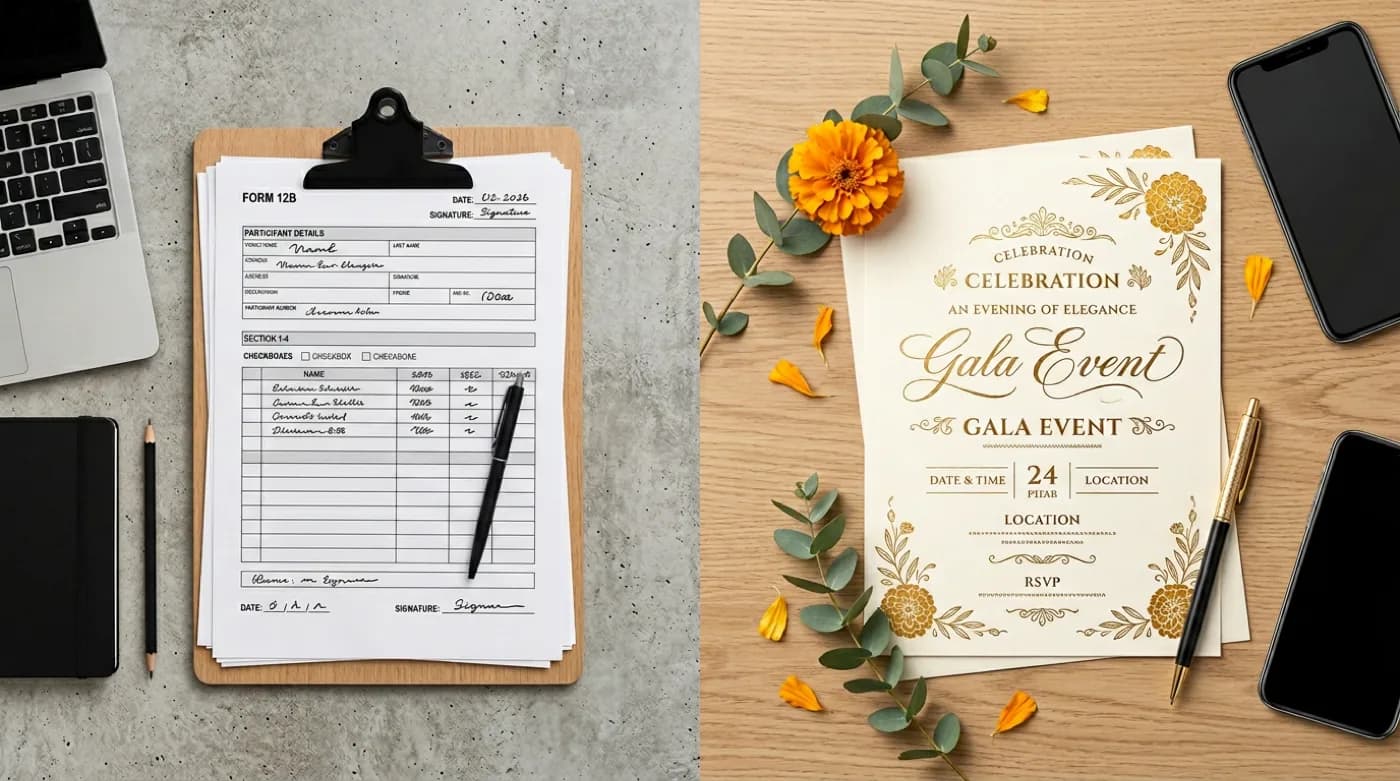
| Printed | Keepsake feel | Slow updates, extra logistics |
| Digital | Instant updates, map/RSVP built-in | Needs good copy + clear link |
| Hybrid | Best of both | Requires planning both |
When digital is clearly better
- Multiple functions/timings
- Venue changes possible
- Large guest list where RSVP matters
- Destination events needing map/hotel info
What to include (quick checklist)
- ✓Host/couple/family names (as you want them displayed).
- ✓Event name + date + start time (and end time if relevant).
- ✓Venue name + full address + Google Maps link.
- ✓Dress code / theme (only if you truly need it).
- ✓RSVP method + last date (button/link/phone).
- ✓Any special note: kids policy, parking, gifts, footwear, etc.
Copy-ready templates
Short & clear (WhatsApp-friendly)
- Event invite for [Name]
- Date: [Day, DD MMM] | Time: [Time]
- Venue: [Venue / Area] (Map: [Link])
- RSVP by [Date]: [RSVP Link/Number]
Warm family tone
- With joy in our hearts, we invite you to join us for Event invite of [Name].
- Your blessings and presence will make the day special.
- Details: [Date, Time, Venue]. RSVP: [Link].
Formal tone
- Request the pleasure of your company at the event invite of [Name] on [Date] at [Venue].
- Kindly RSVP by [Date] at [Link/Number].
Template bank (mix & match)
- You’re invited to event invite of [Name] on [Date] at [Venue]. RSVP: [Link].
- Join us for a joyful event invite celebration for [Name].
- Timing: [Time] | Venue: [Address] | Map: [Link]
- RSVP by [Date] (so we can plan food): [Link]
- Dress: Yellow/white (optional) | Comfortable footwear suggested
- Family-only note: “This is an intimate family gathering.”
- Kids note: “Kids are welcome” / “Adults-only event” (choose one)
- Parking note: “Parking available at [spot]. Entry gate: [X].”
- Gift note (optional): “Your presence is our present.”
- If late: “Please arrive by [time] as the main ritual starts on time.”
- For multiple venues: “Please check the venue line for each function.”
- Contact: “[Name] – [phone] for any help.”
- If you’re late: “Please join by [time]; rituals start on time.”
- If you want photos: “Please arrive by [time] for family photos.”
- If venue has multiple gates: “Entry gate: [X]. Please don’t follow old pins.”
- If it’s a home event: “Please use lift/stairs to [floor]. Ring [bell/flat].”
- If it’s a banquet: “Hall: [Name] | Floor: [X].”
- If it’s a destination: “Hotel: [Name] | Check-in: [time] (optional).”
- If you’re doing multiple events: “Full schedule below—save this message.”
Hinglish lines (ready to copy)
- Event invite ke liye aapko hardik nimantran! [Date] ko [Time] par [Venue].
- Map: [Link] | RSVP: [Link/Number] | Deadline: [Date]
- Aapki presence se celebration aur special ho jayega.
- Thoda sa jaldi aa jaiye—main ritual time par start hoga.
- Agar aap family ke saath aa rahe ho, headcount RSVP me mention kar dena.
Ultra-short versions (status style)
- Event invite: [DD MMM], [Time] — [Venue]. Map: [Link]. RSVP: [Link].
- Event invite for [Name] — [DD MMM] [Time]. Venue: [Link].
- Reminder: Event invite tomorrow [Time]. Map: [Link].
RSVP lines that work
- Please RSVP by [Date] so we can plan seating and food.
- If you’re coming with family, mention total guests/headcount in RSVP.
- If plans change, just update us—no stress.
- If you’re unsure, reply ‘maybe’ now and confirm by the deadline.
WhatsApp format (recommended)
Most guests skim. A WhatsApp message works best when the key facts are in the first 4–6 lines. Keep emojis minimal and keep the link(s) short.
Example message
- Event invite — [Name]
- 📅 [Day, DD MMM] | ⏰ [Time]
- 📍 [Venue, Area] (Map: [Link])
- RSVP by [Date]: [RSVP Link/Number]
- Note: [Parking / dress / kids info if needed]
If you have multiple functions
If Haldi/Mehendi/Sangeet are on different days (or even the same day), list each function as a separate mini-block with its own time + venue. This prevents confusion and reduces last-minute calls.
- Function 1: [Name] — [Date], [Time], [Venue] (Map: [Link])
- Function 2: [Name] — [Date], [Time], [Venue] (Map: [Link])
- RSVP once for all functions: [Link]
Common mistakes to avoid
Do
- Put date/time in a separate line.
- Share a clickable map link (not just a landmark).
- Add RSVP deadline and one clear action.
Do not
- Bury venue details inside a long paragraph.
- Write two different start times in different places.
- Use vague phrases like “evening” without a time.
Helpful links
Keep exploring — invitation hubs
Templates, occasions, and wording — strong paths from this article into the product surface.
FAQs – Printed Card vs Digital Invitation: The Honest Comparison for Modern Indian Weddings
Kya digital invitation bhejna disrespectful hota hai?
Kuch families ke liye haan, kuch ke liye bilkul nahi — yeh family aur relationship par depend karta hai. Generally rule: elders, religious figures, aur traditional business relationships ke liye printed card prefer karein. Friends, colleagues, aur extended young network ke liye digital perfectly acceptable hai. Hybrid approach se yeh dilemma resolve ho jaata hai.
Hybrid approach kaise plan karein?
Apni guest list ko 3-4 tiers me divide karein based on relationship closeness aur formality required. Tier 1 (50-80 closest) ke liye premium printed cards. Tier 2-3 (200-400) ke liye digital invite via WhatsApp with personal message. Tier 4 (extended network) ke liye same digital link forwarded through group messages. Cost-effective bhi hai aur respectful bhi.
Printed card ke kitne extra print karwane chahiye?
Total RSVPs ka 10-15% extra rakhein. Last-minute additions, lost cards, ya keepsake requests ke liye useful. Bahut zyada extra print karna pure waste hai — ek shaadi me typically 5-10% bach jaate hain anyway.
Digital invite link kab tak active rakhein?
Wedding ke baad bhi minimum 6 months tak link active rakhein — guests jinhone photos lene the, RSVP confirm karna tha late, ya keepsake ke roop me save karna hai unke liye. Some platforms permanent links offer karte hain, jo ideal hai.
Kya digital invitation me ‘physical mithai’ ki feel laa sakte hain?
Direct nahi, par kuch creative families ek hybrid kar rahe hain — digital invitation ke saath ek small mithai box courier bhejti hain ek personal note ke saath. Iss tarah ceremony preserve hoti hai bina printed card ki full overhead ke.
Elders ke liye digital invitation ka design kaise simple banayein?
Larger font size (16pt+), high contrast colors, minimal scrolling, single CTA button, voice instruction option (Hindi me), aur WhatsApp ke through directly forward kar dena. Avoid complex animations ya interactive elements — those confuse non-tech-savvy elders.
Environmental impact ke liye sirf digital choose karna sahi decision hai?
Carbon footprint perspective se yes — digital significantly lower hai. Lekin yeh decision sirf environmental nahi hai — cultural aur relational dimensions bhi count karte hain. Hybrid approach often best balance offer karta hai: minimum printed cards for cultural needs, digital for practical reach, overall footprint kafi kam.
Kya ye content har family par apply hota hai?
Nahi—India me customs family/community ke hisaab se change hote hain. Isliye is guide ko practical baseline samjho.
Invite ko short kaise rakhein?
Headline + bullets (date/time/venue/RSVP) rakho, aur extra details ko separate section/link me rakho.
Read next
Continue your learning journey with these related guides.
RSVP
Google Form RSVP vs Dedicated RSVP Page: Honest Comparison for Indian Weddings
Google Form free hai aur setup fast hai — par kya woh aapki wedding RSVP ke liye sahi tool hai? Dedicated RSVP page me kya extra milta hai? Yahan honest comparison across setup time, branding, guest trust, response rate, data quality, aur woh subtle factors jo decide karte hain ki guests actually RSVP karenge ya nahi.
14 min read
Digital invitations
How to Create an Invitation with Map and RSVP: Complete Step-by-Step Guide
Ek invitation jo sirf information nahi deti par guest ke liye action enable karti hai — ek tap me venue map, ek tap me RSVP, ek tap me dietary preference. Yahaan complete step-by-step guide modern digital invitation banane ka, with practical tips on map embedding, multi-venue handling, parking instructions, RSVP field structure, aur mobile testing.
9 min read

Invitation wording
Wedding Invitation Wording Ideas in English: Templates for Every Tone and Function
Carefully crafted English wedding invitation wording for traditional cards, digital invites, and WhatsApp messages — with templates for formal, warm-family, and modern couple-led weddings, plus guidance on what to include and what to leave out.
6 min read
On this page
- Printed cards ka cultural weight
- Digital practical superiority
- Cost ka real comparison
- Pros and cons
- Hybrid approach
- Kab printed card karein
- Kab digital prefer karein
- Common myths
- Environmental considerations
- Final thoughts
- Printed vs digital invitations: the practical approach
- Checklist (copy this)
- Message templates (copy-paste)
- Do’s and don’ts
- FAQs
- If something changes (copy this update)
- Troubleshooting (common scenarios)
- Quick takeaways
- Micro tips that make a big difference
- Printed card vs digital invite
- When digital is clearly better
- What to include (quick checklist)
- Copy-ready templates
- Template bank (mix & match)
- Hinglish lines (ready to copy)
- Ultra-short versions (status style)
- RSVP lines that work
- WhatsApp format (recommended)
- If you have multiple functions
- Common mistakes to avoid