₹5,100 Shagun: The Immediate-Family Amount and the Symbolism of 51 Shakti Peeths
Why ₹5,100 is the immediate-family shagun amount at Indian weddings, the deep symbolism of 51 in Hindu thought — from the Shakti Peeths to the Sanskrit alphabet — and how it works as both an individual and pooled gift.
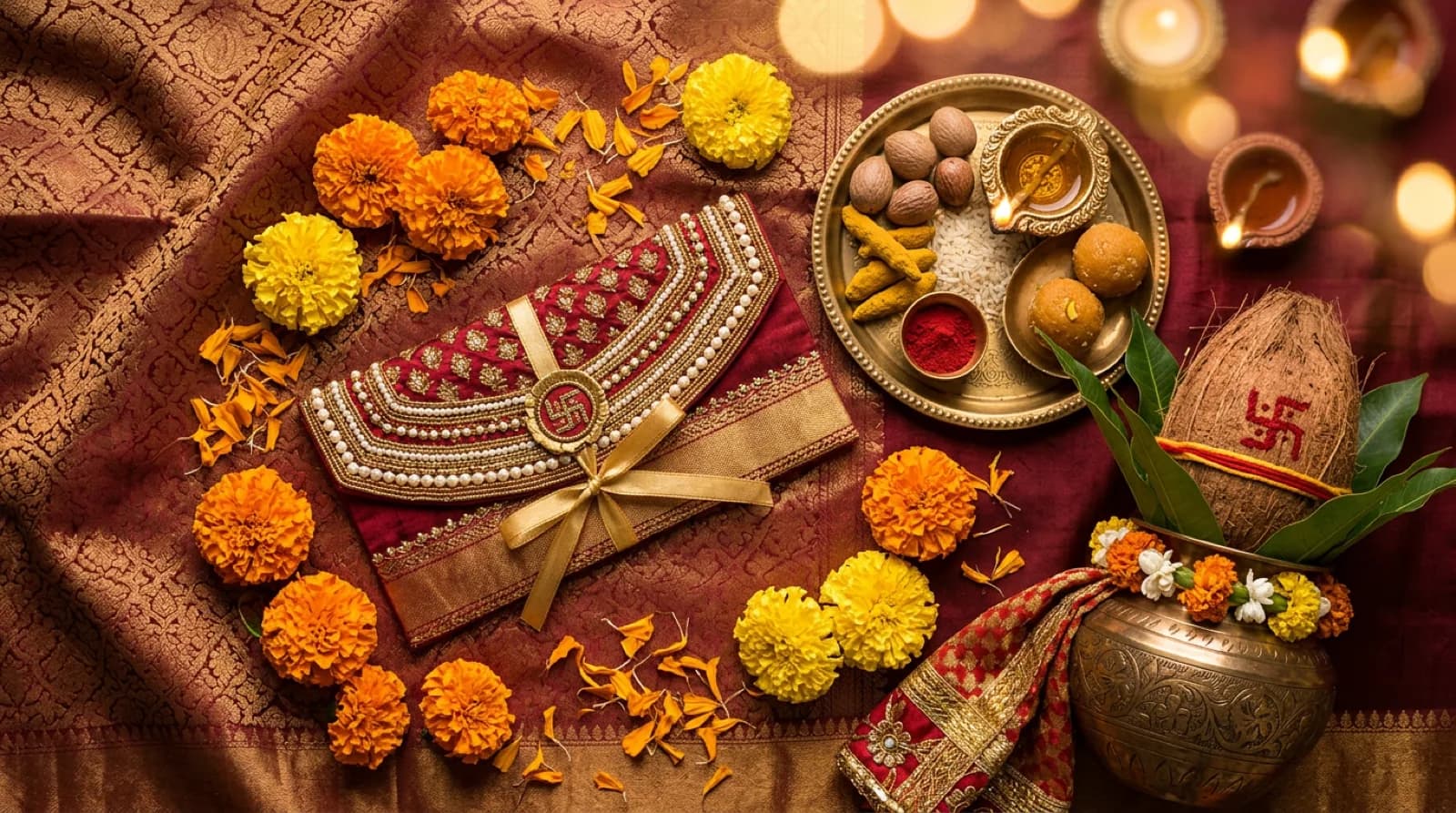
Key takeaway
₹5,100 is the shagun amount given from the smallest, closest circle around a wedding — parents, siblings, mama, lifelong best friends. It is also the most common pooled-contribution amount in modern I…
Quick meaning
₹5,100 draws on the full-spectrum blessing of 51 — the 51 Shakti Peeths and the 51 letters of the Sanskrit matrika — combined with the +₹100 continuity that keeps the blessing open-ended.
What ₹5,100 represents
₹5,100 is the threshold at which shagun stops being a guest gesture and starts being a family contribution. It is what immediate family gives — parents at their child’s wedding, siblings at a sister or brother’s wedding, very close uncles and aunts who have been present in someone’s life from birth, and the small handful of friends whose presence at a wedding feels closer to family than friendship.
Like the smaller shagun amounts, ₹5,100 is built on the +₹1 logic at scale: ₹5,000 is a closed round number, and the +₹100 (visibly larger than the +₹1 of ₹101) carries the same meaning — continuity, indivisibility, an open-ended blessing. Some families use ₹5,001 instead; the principle is the same and the presentation slightly different.
Why fifty-one is auspicious
Of all the shagun amounts, ₹5,100 carries the most direct spiritual reference. Two major cultural anchors give fifty-one its weight:
The cultural anchors of 51
- 51 Shakti Peeths — sacred sites scattered across the Indian subcontinent (including Nepal, Bangladesh, Pakistan, and Sri Lanka) where parts of Sati’s body are said to have fallen. Each is associated with divine feminine energy, protection, and blessing.
- 51 letters of the Sanskrit alphabet (the matrika) — considered to encompass the full sonic vocabulary of mantra, prayer, and blessing. Each letter is associated with a body part of the goddess and a syllable of cosmic creation.
- The compounding of five (the panch tattva, the senses, the elements) and ten (a complete decimal cycle) plus one (the continuing principle) — a complete enumeration plus the open thread.
These references combine to give 51 a feel of full-spectrum blessing — a wish that covers every body part of the goddess and every letter of the sacred alphabet. That is why ₹5,100 is so often described as ‘the blessing that holds everything’ in older families.
When ₹5,100 is the right amount
₹5,100 is given at the most important occasions, from the closest relationships. Typical situations:
Where ₹5,100 fits
- Parents giving shagun at their own child’s wedding (often alongside larger gifts like gold or property).
- Siblings giving at a brother’s or sister’s wedding.
- Maternal uncles (mama) giving to a niece or nephew — culturally significant in many North Indian families.
- Very close aunts and uncles who have been part of someone’s upbringing.
- Lifelong best friends — the friendships that pre-date marriage and feel like chosen family.
- Major engagement of an immediate family member.
- Mama-bhanji rituals and other relationship-specific giving moments in regional weddings.
- Significant milestone events — a parent’s sixtieth birthday, a major business launch within the family.
₹5,100 as pooled shagun
One increasingly common modern use of ₹5,100 is as a pooled amount rather than an individual one. Cousin groups, friend groups, college batches, and office teams often combine multiples of ₹5,100 into larger joint gifts:
Common pooled patterns
- Five cousins × ₹5,100 = ₹25,500 — toward jewellery, furniture, or a curated combined gift.
- Three close friends × ₹5,100 = ₹15,300 — often paired with a written letter or personalised item.
- Office team × ₹5,100 each — toward a wedding gift voucher or honeymoon contribution.
- Two parents’ sides combining ₹5,100 each toward an heirloom item.
Pooled ₹5,100 has become so common in urban India that many wedding registries and digital shagun platforms now structure their default contribution around multiples of this number.
₹5,100 vs ₹2,100 — when to step further up
The shift from ₹2,100 to ₹5,100 happens when the relationship moves from ‘close family’ to ‘immediate family or equivalent’. Some practical signals:
Do
- Give ₹5,100 if you are a sibling, parent, or first uncle/aunt of the couple.
- Use ₹5,100 if you are a lifelong best friend whose presence is treated as family.
- Pool ₹5,100 contributions with cousins toward a meaningful larger combined gift.
- Step up to ₹5,100 if you are the senior elder blessing a junior family member’s wedding.
Do not
- Default to ₹5,100 for every wedding — it loses meaning if given too widely.
- Use ₹5,100 if a smaller amount would actually fit the relationship better — the closeness should match.
- Add even-numbered top-ups (₹5,100 + ₹500 = ₹5,600 breaks the structure).
How ₹5,100 is given
At this level the gift is often less about the envelope and more about the moment. Common conventions:
Presentation
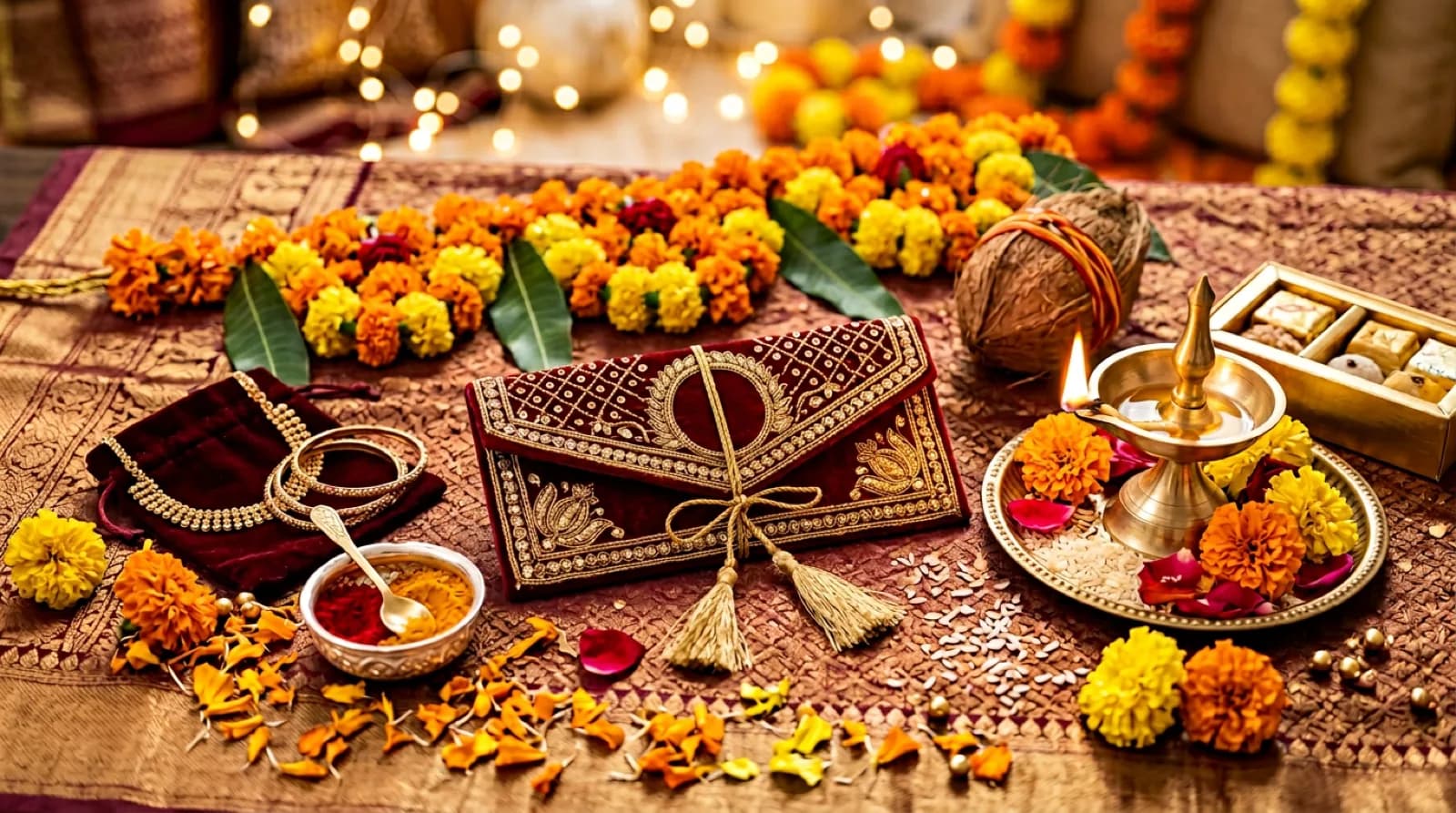
- ✓Premium envelope — embroidered, brocade, or specifically printed for the occasion.
- ✓Crisp notes, often counted out (ten ₹500s and one ₹100, or five ₹1,000s and one ₹100).
- ✓Frequently paired with a larger gift — gold, jewellery, kitchenware, or experiential gifts.
- ✓Given in a private or family-only setting rather than the public reception line.
- ✓Often accompanied by a longer verbal blessing or a written note that the recipient is meant to keep.
- ✓For mama-bhanji or similar relationship-specific giving, given at the ritually appropriate moment with the rest of the family present.
Regional and community variation
₹5,100 is widely understood across Indian communities as an immediate-family amount. In Punjabi and Sikh weddings, ₹5,100 from siblings and mama is a recognised convention, often paired with sewa. In Marwari and Sindhi weddings, ₹5,100 may appear alongside gold coins or jewellery. In Gujarati families, ₹5,100 is common at weddings and Diwali Lakshmi puja for very close family. In South Indian Hindu families, the immediate-family equivalent often falls at ₹5,116 or ₹5,001, with the same structural logic. In Bengali families, similar amounts appear as ashirvad with specific ritual conventions.
Modern context
Digital ₹5,100 is now standard. Wedding invite platforms increasingly bundle digital shagun directly into the RSVP flow, which makes ₹5,100 from distant immediate family — siblings working abroad, lifelong friends in other cities — practical to send before the function. The cultural reading of fifty-one carries fully into the digital format; what matters is the amount and the intention behind it, not the format of the note.
Final thoughts
₹5,100 is the amount of full-presence giving. It is what immediate family contributes when a wedding is the largest family moment of the year, what lifelong friends give when they want the recipient to remember the gesture decades later, and what mama gives when blessing a niece or nephew at the most ritually significant moment of their life. The fifty-one carries the full vocabulary of Sanskrit blessing and the divine protection of the Shakti Peeths; the structure of the amount carries the wish that none of it ever runs out.
Yaad rakhein: Shagun ka exact amount se zyada important hota hai aapka niyat, pyaar aur blessing. Amount sirf ek symbol hai.
Helpful links
Keep exploring — invitation hubs
Templates, occasions, and wording — strong paths from this article into the product surface.
FAQs – ₹5,100 Shagun: The Immediate-Family Amount and the Symbolism of 51 Shakti Peeths
Is ₹5,100 too much from a first cousin?
Not necessarily. Some first cousins who feel closer than ‘second-tier family’ give ₹5,100 — particularly if the relationship is more like sibling than cousin. ₹2,100 is more typical for arms-length first cousins.
How is pooled ₹5,100 typically organised?
A group of cousins or friends each contributes ₹5,100, then combines the total toward a single larger gift — jewellery, furniture, gold, or a honeymoon voucher. The cultural reading of fifty-one is preserved per-contributor.
Should parents give exactly ₹5,100 at their child’s wedding?
Parents typically give much more than ₹5,100 as part of a combined gift package. ₹5,100 may be the ‘shagun envelope’ portion presented ritually, with the larger contribution given separately as gold, jewellery, or other items.
Is ₹5,100 culturally appropriate at non-Hindu Indian weddings?
Yes. ₹5,100 is widely understood across Sikh, Jain, Buddhist, and Indian Muslim communities, though the historical cultural references behind fifty-one are specifically Hindu.
What is the difference between ₹5,100 and ₹5,001?
Both follow the same continuity logic. ₹5,100 is more visible (the +₹100 is felt in the count); ₹5,001 is sleeker. North Indian families more often use ₹5,100; some Bengali and South Indian families prefer ₹5,001.
Read next
Continue your learning journey with these related guides.
Shagun & traditions
₹101 Shagun: Meaning, When to Give It, and Why the Extra Rupee Matters
Why ₹101 is the most common everyday shagun amount in India, what the extra ₹1 actually represents, and when ₹101 is the right choice versus stepping up to ₹501 or higher.
5 min read
Shagun & traditions
₹501 Shagun: Meaning, Cultural Significance of Five, and When to Give It
Why ₹501 is the default shagun for engagements and close-family functions in India, what the number five represents culturally, and how it sits between ₹101 and ₹1,100.
5 min read
Shagun & traditions
₹1,100 Shagun: The Classic North Indian Wedding Amount Explained
Why ₹1,100 is the default wedding shagun across North India, the cultural weight of the number eleven in Hindu tradition, and when ₹1,100 is exactly right — versus when to step further up.
4 min read
Shagun & traditions
₹2,100 Shagun: The Close-Family Wedding Amount and the Significance of 21
Why ₹2,100 is the standard shagun amount from close family at Indian weddings, the cultural meaning of twenty-one in Hindu thought, and when ₹2,100 is exactly the right step above ₹1,100.
5 min read

Hindi messages
Wedding Invitation Message in Hindi: Templates for Cards, WhatsApp, and Digital Invites
Hindi and Hinglish wedding invitation message templates for cards, WhatsApp, and digital invites — with formal Shuddh Hindi versions for elders, warm Hinglish versions for family WhatsApp groups, and short scannable versions for digital invites.
5 min read